The Kelly Criterion: How Much to Bet When You Have an Edge
The Kelly criterion says how much of your wealth to put on a bet you expect to win: the fraction that maximizes the growth rate you live through over time. Why overbetting is worse than underbetting, and what it means for investors.
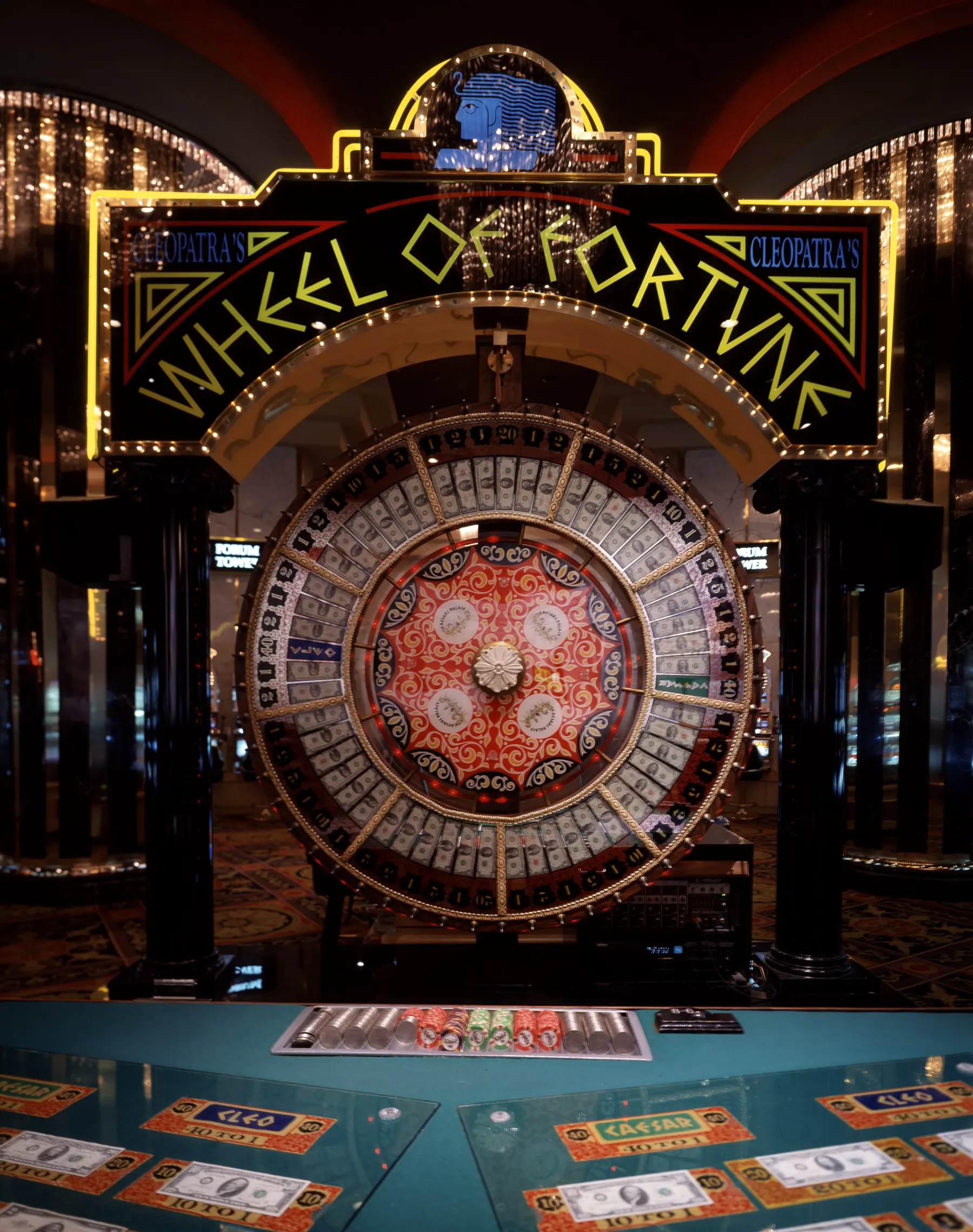
On the image Every bet on this wheel has a house edge, so the Kelly answer is to bet nothing. The formula only tells you how much to bet once the odds are on your side, which is why Thorp took it to blackjack, where card counting could tilt them. Cleopatra's Wheel of Fortune, a money wheel at Caesars Palace, Las Vegas, photographed between 1980 and 2006. Photo: Carol M. Highsmith, Library of Congress, public domain.
The Kelly criterion tells you how much of your wealth to put on a bet you expect to win. It picks the fraction that maximizes the growth rate of your wealth over time, the rate you actually live through when you bet again and again with the same money. For a bet that pays $b$ times your stake with probability $p$ and loses the stake otherwise, the Kelly fraction is $f^* = p - (1-p)/b$.
This is the third piece in a series. The first explains why the average outcome is not the one you live, and the second why your average return overstates your wealth. Kelly is what you do about both.
#Where it comes from
In 1956 John Kelly, a physicist at Bell Labs, published “A New Interpretation of Information Rate.” His setup was a gambler who receives horse race results over a noisy private wire before the bookmakers do. The question was how much the gambler should bet, given that the tips are only sometimes right. Bet nothing and the edge is wasted. Bet everything and one wrong tip wipes you out. Kelly showed that the bet which maximizes the long-run growth rate of wealth is the one that maximizes the expected logarithm of wealth, and that the growth rate it achieves equals the information rate of the wire.
The logarithm is the same one from the earlier pieces. It turns compounding into addition, so maximizing the expected log is maximizing the average growth rate along one path through time.
#The coin, again
Go back to the coin from the first piece: heads multiplies whatever you bet by 1.5, tails by 0.6. Betting everything loses about 5% a round, even though each toss has a positive expected value. Now bet only a fraction $f$ of your wealth each round. Heads multiplies your wealth by $1 + 0.5f$, tails by $1 - 0.4f$, and the growth rate per round is
$$g(f) = 0.5 \ln(1 + 0.5f) + 0.5 \ln(1 - 0.4f)$$
Play with the fraction below. The top panel is $g(f)$, the bottom one shows twenty players making a hundred bets each at the fraction you choose.
Open this simulation in Explore →
Three numbers matter:
- At 25% the growth rate peaks, at about 0.62% a round. That is the Kelly fraction.
- At 50% it is exactly zero. Heads gives $1.25$, tails $0.8$, and $1.25 \times 0.8 = 1$. Betting twice the Kelly fraction earns nothing in the long run, with all the volatility of a much larger bet.
- At 100% it is about −5% a round, the losing game from the first piece.
The curve is close to symmetric around its peak, but its consequences are not. Betting half of Kelly keeps 75% of the growth with half the volatility. Betting twice Kelly keeps none of it.
#Half Kelly
That asymmetry is why almost everyone who uses Kelly in practice bets a fraction of it. The Kelly fraction is only optimal if you know the odds exactly, and you never do. If your estimate of the edge is too high by a factor of two, full Kelly puts you at the breakeven point of the curve. Half Kelly, under the same mistake, puts you at full Kelly.
Drawdowns tell the same story. In the continuous-time version of the problem, Ed Thorp showed that betting a fraction $c$ of Kelly gives a probability of $x^{2/c - 1}$ that your wealth ever falls to a fraction $x$ of where it started. At full Kelly, the chance of ever being cut in half is one in two. At half Kelly it is one in eight. Full Kelly maximizes growth, and the ride is brutal.
#For investors
The same logic applies to how much of your money to keep in a risky asset. For returns that behave like geometric Brownian motion, the Kelly fraction is
$$f^* = \frac{\mu - r}{\sigma^2}$$
where $\mu - r$ is the expected return above the risk-free rate and $\sigma^2$ the variance. With an equity premium of 5% a year and volatility of 18%, full Kelly says to hold about 154% of your wealth in stocks, which means borrowing. Half Kelly says about 77%. If the true premium is 3% instead of 5%, full Kelly falls to about 93%, and the investor who borrowed to reach 154% is now betting well past it.
Two things follow. Leverage is not free: past the Kelly fraction, more exposure lowers your long-run growth, and twice Kelly brings it to roughly the risk-free rate. And because the inputs are uncertain, the honest version of Kelly for investors is a range well below the formula, not the formula itself.
#Checked in Lean
The optimality is proved in lean-ergodicity for any bet with two outcomes: a gain of $u$ per unit staked with probability $p$, a loss of $d$ per unit otherwise. No fraction that keeps your wealth positive grows faster than $(pu - (1-p)d)/(ud)$.
theorem kelly_optimal {p u d f : ℝ} (hp0 : 0 < p) (hp1 : p < 1) (hu : 0 < u) (hd : 0 < d)
    (hf1 : 0 < 1 + u * f) (hf2 : 0 < 1 - d * f) :
    growth p u d f ≤ growth p u d (kellyFraction p u d)
The same file proves that the optimal growth is strictly positive whenever the bet has an edge, that the coin’s Kelly fraction is exactly one quarter, and that betting everything on it shrinks your wealth. A second file proves the investor version: starting from the growth rate of geometric Brownian motion, the Kelly leverage $(\mu - r)/\sigma^2$ is optimal, twice Kelly earns exactly the risk-free rate, and half Kelly keeps exactly three quarters of the excess growth.
#The limits
Kelly maximizes the growth rate of wealth, which is what you care about if you will bet many times and want the most money in the long run. It is not the answer to every question. Paul Samuelson spent years arguing that a person with a fixed horizon and different preferences can rationally choose something else, and he was right that Kelly is a choice, not a law. In 1979 he made the point in an article written entirely in words of one syllable.
The formula also assumes you know the odds, that bets are independent, and that the worst case is the one in your model. Real markets have fat tails, and the bet that ruins you is usually the one your model said could not happen. Kelly with a wrong model is overbetting with a formula attached.
#Further reading
- Ergodicity, Explained: why the coin loses when you bet everything.
- Volatility Drag: why the variance term in Kelly’s formula is a cost.
- Finance Is Geometry: Kelly, Jensen and tail hedging in one long argument.
- John L. Kelly Jr. (1956). “A New Interpretation of Information Rate.” Bell System Technical Journal 35(4).
- Edward O. Thorp (2006). “The Kelly Criterion in Blackjack, Sports Betting, and the Stock Market.” In Handbook of Asset and Liability Management, Volume 1.
- Paul A. Samuelson (1979). “Why We Should Not Make Mean Log of Wealth Big Though Years to Act Are Long.” Journal of Banking and Finance 3(4).
From the series One Path.
Written with an LLM in the loop, like everything here. The ideas and the mistakes are mine. More on how I write.