Markets as Reflexive Fixed Points
Markets are more than noisy aggregators of information: beliefs about prices help determine prices, which makes reflexivity a fixed-point problem with fat tails, non-ergodicity, and hysteresis.
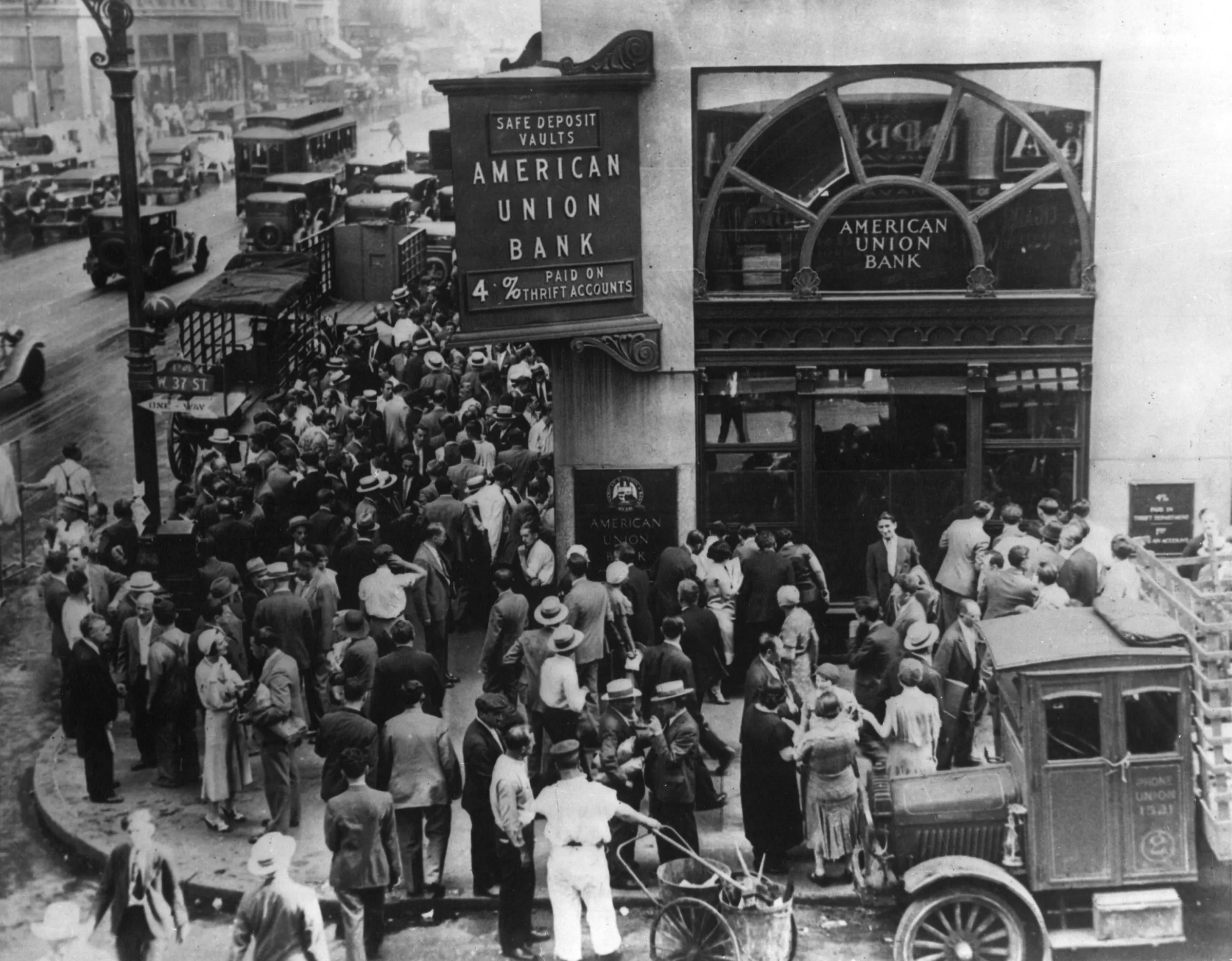
On the image A bank run is a belief that makes itself true: if enough depositors expect the bank to fail and withdraw, it fails. The price of the bank is set by what people think the price will be, which is reflexivity as a fixed point. A crowd outside the American Union Bank during a run, New York, 1931. Photo: National Archives, public domain, via Wikimedia Commons.
Markets are the cleanest laboratory for reflexive dynamics.
Prices are not determined by beliefs alone. Cash flows, constraints, inventories, regulation, leverage, and flows all matter. But beliefs about prices become trades, trades become prices, and prices update beliefs.
That loop is the object.
Biology reaches critical-like organization through selection, feedback, and development over evolutionary time. Markets can generate critical-like statistics much faster, because the feedback loop is explicit. Participants model the market while participating in the market. Their models are not external descriptions. They are part of the thing being described.
The careful claim is not that every market is literally sitting at a physical critical point. The claim is narrower and stronger: reflexivity, leverage, liquidity, imitation, and coarse-graining can make markets behave like systems near criticality. They produce fat tails, volatility clustering, correlated cascades, hysteresis, and path dependence.
#The Minimum Vocabulary
Reflexivity means the description of the system affects the system being described. In markets, a belief about prices can become an order, and the order can move prices.
An order book is the current set of resting bids and offers. It is a local picture of liquidity: how much can be bought or sold before the price has to move.
Liquidity means the ability to trade without moving the price too much. Low liquidity makes feedback stronger because a given flow moves the state more.
Leverage means controlling a position larger than one’s own capital. It amplifies gains, losses, forced selling, and contagion.
Margin is collateral required to keep a leveraged position open. If losses reduce equity below the required level, positions must be reduced or liquidated.
Volatility clustering means large moves tend to be followed by large moves, and quiet periods tend to be followed by quiet periods. This is one reason market risk is not well described by independent Gaussian shocks.
Coarse-graining means replacing fine detail with larger-scale summaries. In markets, that can mean aggregating trades over longer time windows.
A tail exponent describes how quickly rare large events disappear. For a survival tail:
$$P(|R|>x)\sim Cx^{-\alpha},$$
smaller $\alpha$ means a heavier tail.
Hysteresis means the path matters. A system can move from one regime to another and fail to return along the same route when the original parameter is reversed.
#The State Space Of A Market
A market is not just a price series. Price is the visible coordinate, but it is not the whole state.
A minimal state vector might include:
$$x_t=(p_t,b_t,L_t,Q_t,\sigma_t,C_t),$$
where:
- $p_t$ is price,
- $b_t$ is the distribution of beliefs or forecasts,
- $L_t$ is leverage,
- $Q_t$ is liquidity depth,
- $\sigma_t$ is perceived volatility,
- $C_t$ is cross-asset correlation.
This is still a caricature. Real markets include inventories, funding constraints, market makers, options dealers, passive flows, regulation, news, taxes, settlement, and institutional mandates. But even this reduced state is enough to show why markets are nonlinear.
The variables do not move independently. If price falls, volatility estimates rise. If volatility rises, risk limits tighten. If risk limits tighten, positions are cut. If positions are cut into low liquidity, price falls again. That is a feedback loop, not a sequence of independent shocks.
So the market update has the same form as every dynamical system in the series:
$$x_{t+1}=F(x_t,\eta_t),$$
but now part of $x_t$ is made of beliefs about $F$ itself. That is the extra reflexive ingredient.
#What Is A Belief Variable?
“Belief” sounds psychological, but the market version can be made concrete.
A belief is any rule that maps information into desired position:
$$\text{information}\longrightarrow\text{forecast}\longrightarrow\text{order}.$$
A discretionary investor may express this as a story: “earnings will accelerate, so the stock is cheap.” A trend follower may express it as a rule: “if twelve-month momentum is positive, buy.” A market maker may express it as an inventory-adjusted quote. A risk model may express it as a volatility target. A passive index fund may express almost no forecast, but it still follows a rule that converts flows into trades.
At the population level, beliefs are not one number. They are a distribution of strategies:
$$b_t=\text{distribution of forecasts, constraints, and trading rules at time }t.$$
That distribution is part of the market state because it determines future flow. If enough capital uses the same model, the model becomes a force. If the model stops working, capital leaves it, and the distribution changes.
#Reflexivity As A Fixed-Point Problem
Participants model the market. Their models generate trades. The aggregate of trades sets prices. Realized prices update the models.
At the level of the strategy ecosystem:
$$\text{distribution of models}=F(\text{distribution of models}).$$
This is Keynes’ beauty contest in fixed-point language. The market is not only asking what an asset is worth. It is asking what others believe others will believe it is worth.
Soros called this reflexivity. In the language of this series, reflexivity is representational closure made institutional. A market is a system where descriptions of the system feed back into the system’s state.
This does not mean markets are irrational noise. It means the object being priced is partly shaped by the act of pricing. That is why the fixed point can be unstable, non-unique, or unreachable by simple dynamics.
The mechanism is concrete:
- participants model the market,
- models generate trades,
- trades move prices,
- prices update the models,
- profitable models attract capital,
- capital changes the market that made the models profitable.
At that point the meta-level is financialized. There is not only a market in assets; there is a market in models of the market. Hedge funds, factor portfolios, risk models, execution algorithms, and passive rules all compete to become the dominant description. The distribution of models is determined by outcomes, and outcomes are determined by the distribution of models.
That is why the fixed-point equation belongs at the level of the strategy ecosystem:
$$\text{distribution of strategies}=F(\text{distribution of strategies}).$$
In equilibrium language, this is related to Nash. In Keynes’ language, it is the beauty contest. In Soros’ language, it is reflexivity. In the language of the previous essay, it is representational closure: the system contains models of itself that help produce itself.
This is where the first two essays pay off. A reflexive fixed point is not automatically an attractor. The logistic fixed point $x^\star=1-1/r$ keeps existing past $r=3$, but it stops attracting: nearby states orbit it instead of settling into it. The market’s belief-fixed-point can behave the same way. Leverage, crowding, and the speed of feedback play the role of control parameters. Past a threshold, the fixed point can lose stability. Prices then do not converge to it. They may oscillate, trend, overshoot, or jump between regimes.
This is not a proof that every reflexive market is critical. It is a mechanism. Reflexivity supplies feedback. Leverage amplifies feedback. Liquidity constraints make feedback nonlinear. When those forces interact across many scales of capital and time, the system can produce the empirical signatures associated with criticality: clustered volatility, fat tails, drawdowns of many sizes, and sudden correlation spikes.
A bubble is not simply “people being wrong.” It is a reflexive regime in which price increases validate the beliefs that caused buying, attracting more capital into the same belief. A crash is not simply “the truth arriving.” It is often the bounded system forcing positions back through liquidity constraints, margin calls, and risk limits.
A minimal reflexive model has two state variables: price $p_t$ and belief $b_t$.
$$p_{t+1}=F(p_t,b_t),$$
$$b_{t+1}=G(b_t,p_{t+1}).$$
A non-reflexive model would treat beliefs as external or fixed. A reflexive model lets beliefs and prices update each other. A local equilibrium is a fixed point:
$$p^\star=F(p^\star,b^\star),\qquad b^\star=G(b^\star,p^\star).$$
Stability is then a Jacobian question. Linearize the two-dimensional map around $(p^\star,b^\star)$. If the eigenvalues stay inside the unit circle, perturbations decay. If an eigenvalue crosses the unit circle, the market can move into oscillation, trend amplification, or regime change. This is the same local-stability logic as the logistic map, but the state now includes beliefs about the state.
To make this concrete, use the simplest linearized form:
The coefficient $c$ says beliefs move prices. The coefficient $d$ says prices update beliefs. Reflexivity is the product $cd$. If $cd$ is small, the loop damps. If $cd$ is large, the loop amplifies. The eigenvalues of the matrix tell you which regime you are in.
This is also where two famous worldviews turn out to be the same local stability question. Reflexivity has a sign. When the loop is self-correcting, a belief that pushes the price too high invites the trades that pull it back, the eigenvalues sit inside the unit circle, and prices track fundamentals: that is the efficient-market picture. When the loop is self-reinforcing, a belief that pushes the price up invites trades that validate the belief and push it further, an eigenvalue crosses the unit circle, and you get bubbles and crashes: that is Soros’s reflexivity. They are not rival equations for how markets work. They are different regimes of the same two-variable map. The product $cd$ measures the direct feedback loop, but the stability threshold is the spectral radius of the whole Jacobian, the same threshold from the first essay, now deciding whether a market self-corrects or runs away. The disagreement is empirical, about which regime a given market is in and when, not about the mathematics.
One caveat, stated plainly so the move is not oversold: this “same map, two regimes” reading is the interpretive lens this series brings, not a treaty Fama and Soros would both sign. Fama largely rejects reflexivity as too imprecise to test; Soros regards the efficient-market hypothesis as a damaging idealization. The reconciliation is what the dynamical-systems framing adds, not a neutral account each camp would endorse. What the framing does earn is a sharper question: instead of asking which side is right in general, ask which regime a given market is in, and what is pushing its loop gain across the line.
This is the same mathematics as a two-dimensional feedback controller. Finance adds a nasty feature: the coefficients themselves change during stress. Liquidity $Q_t$ falls, leverage constraints bind, and volatility estimates rise. So the matrix that looked stable in calm conditions can become unstable exactly when it matters.
#Simulation: Reflexive Feedback
Open this simulation in Explore →
#Leverage As Nonlinear Feedback
Leverage is the mechanism that makes market dynamics path-dependent.
Suppose a fund has equity $E$ and holds an asset position worth $A$. Its leverage is:
$$\ell=\frac{A}{E}.$$
If the asset falls, $A$ falls, but equity falls faster because equity is the residual claim after debt. That means leverage rises after losses.
Example: a fund has $100$ of equity and $400$ of assets, so leverage is $4\times$. If the asset falls by $10%$, the asset position loses $40$. Equity falls from $100$ to $60$. Assets are now $360$. Leverage becomes:
$$\ell=\frac{360}{60}=6.$$
The fund did not buy more. Leverage rose because losses consumed equity.
If the fund has a leverage limit, it must sell. Selling pushes price down if liquidity is limited. A lower price creates more losses for similar funds. Those funds sell too. That is the leverage-liquidity loop:
$$\text{price drop}\rightarrow\text{higher leverage}\rightarrow\text{forced selling}\rightarrow\text{lower price}.$$
This is why the market state includes both leverage and liquidity. A price decline in a deeply liquid, low-leverage market can be absorbed. The same decline in a crowded, leveraged, low-liquidity market becomes endogenous.
#Simulation: Leverage Cascade
Open this simulation in Explore →
#Scale-Free Statistics
Financial returns carry a cluster of statistical facts that no Gaussian model reproduces:
- fat-tailed returns,
- volatility clustering,
- power-law order sizes,
- drawdowns at many scales,
- correlations that jump during crises.
These are measurements, not interpretations. Whatever one decides to call the regime that produces them, the regime is not the textbook one of independent normal shocks.
Mantegna and Stanley documented scaling behavior in the S&P 500 across time scales. Bouchaud and collaborators developed the broader statistical-physics view of markets as collective systems with heavy tails, clustered volatility, and endogenous crises. Gabaix and coauthors connected large market moves to the size distribution of large institutions and trades. Sornette developed the crash-as-critical-phenomenon line through drawdowns, herding, and log-periodic precursors. These are not identical mechanisms, but they point to the same warning: the tails are not small Gaussian errors.
The inverse-cubic law for equity returns is often summarized as:
$$P(|R|>x)\sim x^{-3}.$$
Precision matters: $\alpha\approx 3$ implies finite variance in the ideal tail-index convention. Equity returns are far from Gaussian, but they are not automatically in the infinite-variance Lévy-stable regime Mandelbrot first emphasized.
The important claim is not “variance never exists.” The important claim is that the Gaussian picture fails badly in the region that matters most: large deviations, clustered volatility, drawdowns, leverage cascades, and the sudden alignment of correlations during crises.
This is why the $\alpha\approx 3$ caveat matters. The inverse-cubic law is fat-tailed but not the same as the Lévy-stable infinite-variance case with $\alpha<2$. A precise article should not claim infinite variance for liquid equity returns as a blanket fact. The stronger and more defensible statement is that return tails are far too heavy for Gaussian risk models, and the dynamics that create the tails also create volatility clustering and crisis correlations.
Volatility clustering is the easiest way to see why “random shocks” is too weak a model. A simple GARCH-style process writes returns as:
$$r_t=\sigma_t\epsilon_t,$$
with conditional variance updating as:
$$\sigma_{t+1}^2=\omega+\alpha r_t^2+\beta\sigma_t^2.$$
The shock $\epsilon_t$ can be ordinary noise. The memory is in $\sigma_t$. A large return today raises tomorrow’s conditional volatility through the $\alpha r_t^2$ term. The $\beta\sigma_t^2$ term keeps volatility elevated. That is how large moves cluster without requiring each shock to be independently enormous.
#Simulation: Volatility Clustering
Open this simulation in Explore →
Fat tails do not by themselves prove criticality, because a power law can come from several mechanisms:
- preferential attachment,
- multiplicative growth,
- mixtures of volatility regimes,
- self-organized criticality,
- constrained optimization under feedback,
- strategic imitation and crowding.
So the inference “fat tails, therefore criticality” is invalid, and this essay does not make it. What it claims instead comes in three layers, and the layers are worth keeping apart, because they do not carry the same weight:
- Fact. Return tails are far heavier than Gaussian, volatility clusters, and correlations jump toward one in a crisis. This is measured.
- Mechanism. Reflexive feedback, leverage, liquidity constraints, imitation, and multi-scale capital flows convert small shocks into large ones. That loop, not a fat-tailed noise term bolted on by hand, is what produces the facts in the first layer. This is a causal claim, and it is the one the essay rests on.
- Interpretation. Those same fingerprints are what critical systems often display, so criticality is a tempting and occasionally useful analogy. It is the weakest layer, and nothing in the first two depends on it.
The fat tails stand on the mechanism, not on the label. That is why the essay leans on the word reflexive rather than critical: the mechanism is defensible on its own terms, and the phase-transition analogy is a bonus laid on top, not the foundation underneath.
#Coarse-Graining And Universality
Aggregate trades over one minute, one hour, one day, one month. If the statistical shape persists after rescaling, the market is near a fixed point of a coarse-graining operator. This is the intuition behind the scaling work of Mantegna and Stanley, and behind the broader econophysics literature that treats returns as distributions transformed by time aggregation.
That is the renormalization-group viewpoint:
$$T(P)=P.$$
Different markets can share tail exponents because they sit in the same basin of attraction. The empirical claim is approximate, finite-range, and instrument-dependent, but the recurrence of similar exponents across markets is exactly the kind of pattern that makes a renormalization viewpoint tempting.
This is the finance version of renormalization. Details differ across venues, countries, regulations, participants, and technologies, but some exponents and scaling patterns recur. When details change and exponents persist, universality is the right suspicion.
The same caution applies as in physics: universality does not mean all mechanisms are identical. It means the large-scale statistics are governed by a smaller set of relevant variables than the microscopic complexity suggests.
The coarse-graining operation can be written schematically. Let $R_{\Delta t}$ be returns measured over interval $\Delta t$. Aggregating time means replacing many short returns with a longer return:
$$R_{k\Delta t}=\sum_{i=1}^k R_{\Delta t,i}$$
for log returns. A Gaussian world has a familiar scaling:
$$R_{k\Delta t}\sim \sqrt{k}R_{\Delta t}.$$
A critical or fat-tailed world can show slower convergence, tail persistence, volatility clustering, and scaling that is only approximate across finite ranges. The important question is not whether markets are perfectly scale invariant. They are not. The question is why approximate scaling survives across enough time scales to matter for risk.
This is where the connection to Lawvere should be handled carefully. A financial market is not literally a category satisfying Lawvere’s theorem. But it has the same structural problem Lawvere isolates: representation and evaluation live inside the system. Participants represent possible market maps; their actions evaluate those representations against the market; the result changes the object being represented.
That is why markets can self-tune faster than many physical systems. A magnet needs an external temperature knob. A market has internal reflexive knobs: leverage, imitation, risk limits, model adoption, and capital flows move in response to the market’s own state.
#Non-Ergodicity
For wealth:
$$W_{t+1}=W_t(1+r_t),$$
the ensemble average depends on $\mathbb{E}[r]$, but the lived path depends on:
$$\mathbb{E}[\log(1+r)].$$
A strategy can have positive expected return and still destroy a typical investor through time. Kelly is the ergodicity-corrected response: optimize long-run growth, not ensemble expectation.
This is why finance makes non-ergodicity emotionally obvious. In biology, failed trajectories are extinct lineages. In finance, they are bankrupt funds, forced sellers, margin calls, and investors who cannot stay in the game long enough for the ensemble average to matter.
No investor is the ensemble. Each investor follows one path.
This is also why positive expected return is not enough. If the downside path can force liquidation, then the strategy is not evaluated by its ensemble mean. It is evaluated by survival through time. The Kelly criterion is not merely a betting trick; it is the fixed-point ladder’s ergodicity correction in portfolio form.
The smallest example is enough. Suppose each period has a 50 percent chance of gaining 50 percent and a 50 percent chance of losing 40 percent.
The ensemble arithmetic return is:
$$\frac{1}{2}(0.50)+\frac{1}{2}(-0.40)=0.05.$$
Positive five percent.
But the time-average log growth is:
$$\frac{1}{2}\log(1.5)+\frac{1}{2}\log(0.6)=\frac{1}{2}\log(0.9)<0.$$
The average wealth across many parallel copies can rise while the typical compounded path decays. That is the whole ergodicity problem in one line.
#Hysteresis
Crises are not rewinds. The pre-crisis attractor gives way to another attractor: higher volatility, wider spreads, forced deleveraging, broken institutions, changed regulation, changed models.
The path back is not the path down. That is hysteresis.
Markets add a special fact biology hides: the self-reference is explicit. Strategies model the market; strategies are traded; successful models reshape the environment that made them successful.
After 2008, the market did not simply return to its previous basin. Balance sheets changed. Regulation changed. Central banks changed their role. Risk models changed. Passive investing accelerated. The post-crisis attractor was structurally different from the pre-crisis attractor.
That is the same mathematics as ecological regime shifts and climate tipping points: once the basin changes, reversing the parameter does not necessarily restore the old state.
The pre-crisis attractor was low volatility, tight spreads, rising leverage, and low perceived correlation. The crisis attractor was high volatility, forced deleveraging, wide spreads, and correlations jumping toward one. The post-crisis attractor was not the original state restored; it was a new basin with central-bank dominance, altered regulation, changed balance sheets, and a different ecology of strategies.
This is the market version of a multi-attractor system. Let $L$ represent leverage, $V$ volatility, $S$ spread width, and $C$ cross-asset correlation. The pre-crisis regime has roughly:
$$L \uparrow,\quad V \downarrow,\quad S \downarrow,\quad C \downarrow.$$
The crisis regime flips the signs:
$$L \downarrow\ \text{forcibly},\quad V \uparrow,\quad S \uparrow,\quad C \uparrow.$$
Those arrows are not independent variables moving separately. They reinforce each other. Forced deleveraging raises volatility; higher volatility tightens risk limits; tighter risk limits force more selling; more selling widens spreads and raises correlations. The system changes basin through feedback.
#The Single Statement
Living systems and financial systems both produce the fingerprints of criticality, fat tails, scale-free fluctuations, cascades of many sizes, but they earn those fingerprints differently, and the evidence is not equally strong in the two cases.
Biology arrives there slowly, through dissipation, feedback, selection, and self-reproduction over evolutionary time.
Markets arrive there fast, through reflexivity, leverage, imitation, constraints, and the trading of models that model the market. The loop is explicit, which is why a market can change regime in an afternoon while a lineage takes epochs.
In both cases, the system is not a passive object described from outside. It is a system whose internal dynamics help determine the object being described. That is why the fixed-point ladder matters. Engine A drives systems onto attractors. Engine B makes self-description unavoidable once a system can represent enough of itself. Where both engines run together, the result is a system that survives in basins, adapts near critical boundaries, produces power-law or power-law-like statistics, and changes regimes hysteretically.
The thirteenth lesson:
A market is a reflexive fixed-point problem: prices, beliefs, and strategies solve for one another, so its equilibrium is self-made, often critical-like, and quick to lose stability.
The invariant summary of this essay is:
$$ x_{t+1}=F(x_t,\eta_t), $$
but with beliefs and strategies inside the state:
$$ x_t=(p_t,b_t,L_t,Q_t,\sigma_t,C_t). $$
At the strategy level the fixed-point problem is:
$$ \mu_{t+1}=\Phi(\mu_t,\text{prices produced by }\mu_t). $$
Markets become reflexive when the descriptions inside $\mu_t$ help create the prices that select the next $\mu_{t+1}$. That is why the output is not a calm equilibrium but a moving regime structure with fat tails, cascades, and hysteresis.
#The Same Skeleton
The domains are different, but the pattern repeats:
- choose a space,
- choose a transformation,
- apply it repeatedly or let it act on itself,
- find what remains invariant,
- study whether that invariant object is stable.
| Domain | Engine | Space | Transformation | Fixed or invariant object | What can go wrong |
|---|---|---|---|---|---|
| Banach contraction | A: iteration | Metric space | $x\mapsto f(x)$ | Unique fixed point $x^\star$ | No completeness, no contraction, multiple limits |
| Attractors | A: iteration | State space | Time evolution | Point, cycle, or strange attractor | Basin boundaries, unstable fixed points |
| Logistic map | A: iteration | Interval $[0,1]$ | $x\mapsto rx(1-x)$ | Stable fixed point, then periodic orbit | Bifurcation and loss of stability |
| Feigenbaum universality | A: iteration | Space of maps | Renormalization $\mathcal{R}$ | Fixed function $\mathcal{R}(g)=g$ | Accumulation of bifurcations into chaos |
| Strange attractors | A: iteration | Phase space | Stretch and fold | Fractal invariant set | Sensitive dependence on initial conditions |
| Power laws | A: iteration | Distributions | Rescaling $x\mapsto \lambda x$ | Scale-invariant tail $x^{-\alpha}$ | Infinite variance or infinite mean |
| Ergodicity economics | A: iteration | Wealth paths | Multiplication through time | Time-average growth rate | Ensemble average differs from lived trajectory |
| KAM theory | A: iteration | Phase space tori | Perturbed Hamiltonian flow | Surviving quasi-periodic torus | Resonance, small denominators |
| Gödel/Turing | B: self-reference | Syntax encoded as numbers | Diagonal self-application | Self-referential sentence or program | Incompleteness, undecidability |
| Recursive types | B: self-reference | Category of types | Functor $F$ | $\mu F$ or $\nu F$ | Nontermination, infinite unfolding |
| Lawvere | B: self-reference | Category with representation | Abstract diagonal | Fixed point of every endomap | Paradox when self-reference is too strong |
| Life | A + B | Organism state plus genome | Dissipative dynamics plus self-reproduction | Double fixed point: attractor plus quine-like reproductive loop | Death, loss of canalization, runaway instability |
| Markets | A + B | Prices plus strategy ecosystem | Reflexive coarse-graining | Critical-like or Nash-like fixed point of beliefs, strategies, and prices | Crashes, hysteresis, forced liquidation, ruin |
The table is the series in compressed form. The details matter, but the high-level move is stable: a rule acts on a space, and some object becomes special because the rule cannot move past it. Sometimes the object is stable and useful. Sometimes it is unstable and dangerous. Sometimes it is impossible, and that impossibility becomes a theorem.
#The Whole Ladder
If I compress the whole series into one sentence:
Repeated transformations create state fixed points. State fixed points become attractors. Attractors change under parameters. Those changes can create chaos. Chaos can leave fractal invariant sets and invariant measures. Scale invariance, whether geometric, statistical, or renormalized, creates power-law forms. Power laws can make time averages diverge from ensemble averages. Following one trajectory through time forces the study of recurrence, and recurrence brings arithmetic through rational approximation and resonance. Arithmetic can also encode syntax; once syntax is encoded, self-reference produces representational fixed points, or proves that such fixed points are impossible, in logic, computation, and category theory. Biology and markets are where the two engines meet: systems that survive in attractor basins while carrying internal descriptions that help reproduce or price the system itself.
That is the ladder.
Everything else, Feigenbaum, KAM, Gödel, Turing, Zipf, Mandelbrot, Lawvere, Waddington, Kauffman, Soros, Mantegna, Stanley, Kelly, is a different place where the same skeleton becomes visible.
#What Expressiveness Buys, And What It Does Not
There is a tempting one-sentence compression of the whole series: make a system expressive enough and power laws and fractals will follow. The sentence is close, and wrong in an instructive way, because the ladder is really two claims that do not reduce to each other.
The two claims also use the series’ central phrase in two different senses, and this is the place to keep them apart. A state fixed point is a configuration the dynamics cannot move, $f(x^\star)=x^\star$; you find it by running time forward and watching where the system settles. A representational fixed point is a description that evaluation hands back unchanged, a quine, a Gödel sentence; you find it by diagonalization, and no time is involved anywhere. Same abstract equation, $T(x)=x$, but a different space and a different transformation. Attractors, power laws, and fat tails all live on the state side. Self-reference lives on the representational side.
Expressiveness alone does not buy power laws. What expressiveness buys, and this is the Lawvere, Gödel, and Turing rung of the ladder, is representational fixed points. Once a system can represent enough of its own maps, diagonalization becomes unavoidable: Gödel sentences, halting problems, Y combinators, quines. But nothing about that makes anything fluctuate. Peano arithmetic is as expressive as a system can be, and it has no fat tails, because it has no dynamics at all.
And power laws do not require expressiveness. The sandpile is the cleanest counterexample: it sheds beautiful scale-free avalanches while being unable to represent anything. Slow drive, threshold, leakage. No beliefs, no models, no self-description. The point cuts the other way too, and this essay already made it: “fat tails, therefore criticality” is an invalid inference, because power laws come from preferential attachment, multiplicative growth, and volatility mixtures just as easily as from critical points.
So the honest compression has three parts rather than one. Iteration and feedback make state fixed points inevitable: attractors, the configurations a system settles into. Expressiveness makes representational fixed points inevitable: the descriptions that fold back onto themselves. And the thesis of the series lives at the intersection: when a system is expressive and its self-descriptions are wired back into its own dynamics, which is what the last two essays have called representational closure, the two senses of fixed point stop being separate subjects. Evaluating the descriptions moves the state, and the state rewrites the descriptions. Self-reference stops being a logical curiosity and becomes a force. Models of the market trade in the market. The genome’s description of the organism builds the organism. At that point the feedback loops are strong, internal, and self-tuning, and critical-like behavior, with its power laws, cascades, and hysteresis, becomes a regime the system reaches fast and leaves reluctantly, rather than a knife-edge someone would have to balance it on. A magnet needs an external temperature dial. A market carries its dials inside.
Even at the intersection, the claim is “tends toward,” never “will have.” The series rests on the mechanism, not the label, and that is why this essay leans on the word reflexive rather than critical.
#References And Further Reading
This series is a guided synthesis, not a replacement for the original sources. The references below are the places I would send someone who wants to make each rung precise.
For dynamical systems and chaos:
- Steven Strogatz, Nonlinear Dynamics and Chaos. The best first book for fixed points, stability, bifurcations, and the logistic map.
- Robert May, Simple mathematical models with very complicated dynamics (1976). The classic short paper that made the logistic map famous outside pure dynamics.
- Mitchell Feigenbaum, Quantitative universality for a class of nonlinear transformations (1978). The period-doubling universality paper.
- Robert Devaney, An Introduction to Chaotic Dynamical Systems. A more mathematical route into chaos, symbolic dynamics, and fractals.
- Tien-Yien Li and James Yorke, Period three implies chaos (1975). The famous theorem behind the slogan.
- Stephen Smale, Differentiable dynamical systems (1967). A foundational paper for modern dynamical systems.
- Heinz-Otto Peitgen and Peter Richter, The Beauty of Fractals. A good route into Newton fractals and visual complex dynamics.
- Henri Poincaré, Science and Method (1908). Where dynamical-systems thinking and sensitive dependence on initial conditions begin.
- David Ruelle and Floris Takens, On the nature of turbulence (1971). The paper that named the strange attractor.
- Jean-Pierre Eckmann and David Ruelle, Ergodic theory of chaos and strange attractors (1985). The canonical review of chaos, Lyapunov exponents, and invariant measures.
For fractals, scaling, and power laws:
- Benoit Mandelbrot, The Fractal Geometry of Nature. The source for the modern fractal worldview.
- Per Bak, Chao Tang, and Kurt Wiesenfeld, Self-organized criticality (1987). The sandpile paper behind many later power-law stories.
- Mark Newman, Power laws, Pareto distributions and Zipf’s law (2005). A clear survey of where power laws appear and how to reason about them.
- Aaron Clauset, Cosma Shalizi, and Mark Newman, Power-law distributions in empirical data (2009). Important because it explains how easy it is to fool yourself when fitting power laws.
- Kenneth Wilson, The renormalization group and critical phenomena (1983 Nobel lecture). The clean conceptual source for renormalization and critical exponents.
- Herbert Simon, On a class of skew distribution functions (1955). The Yule-Simon preferential-attachment mechanism.
- Albert-Laszlo Barabasi and Reka Albert, Emergence of scaling in random networks (1999). The modern network version of rich-get-richer scaling.
- Edwin Jaynes, Information theory and statistical mechanics (1957). Maximum entropy, the information-theoretic route to power-law forms.
For ergodicity and multiplicative dynamics:
- Ole Peters, The ergodicity problem in economics (2019). The cleanest entry point into the time-average versus ensemble-average distinction.
- Nassim Nicholas Taleb, The Black Swan and Statistical Consequences of Fat Tails. Useful for the Extremistan intuition and for the dangers of thin-tailed thinking.
- John Kelly, A new interpretation of information rate (1956). The original Kelly criterion paper, where logarithmic growth becomes operational.
- George Birkhoff, Proof of the ergodic theorem (1931). The theorem behind time averages equaling space averages.
- Lasota and Mackey, Chaos, Fractals, and Noise. A useful source for invariant densities and Perron-Frobenius operators.
- Ole Peters and Murray Gell-Mann, Evaluating gambles using dynamics (2016). The sharpest single statement of the time-average argument.
For number theory inside dynamics:
- Vladimir Arnold, Mathematical Methods of Classical Mechanics. The canonical route into Hamiltonian mechanics and action-angle variables.
- Jurgen Moser, Stable and Random Motions in Dynamical Systems. A classic treatment of KAM ideas.
- Hendrik Broer and Floris Takens, Dynamical Systems and Chaos. Useful for connecting invariant tori, bifurcations, and resonance.
- Andrey Kolmogorov, On conservation of conditionally periodic motions for a small change in Hamilton’s function (1954). The original KAM note, the K in KAM.
For logic, computation, and self-reference:
- Kurt Gödel, On formally undecidable propositions of Principia Mathematica and related systems (1931). The incompleteness paper.
- Alan Turing, On computable numbers, with an application to the Entscheidungsproblem (1936). The halting problem and the modern idea of computation.
- Douglas Hofstadter, Gödel, Escher, Bach. Not the most formal source, but still one of the best ways to feel why self-reference matters.
- Raymond Smullyan, Gödel’s Incompleteness Theorems. A gentler logical path into diagonalization.
- Haskell Curry and Robert Feys, Combinatory Logic. A classical source for fixed-point combinators.
- Henk Barendregt, The Lambda Calculus. The standard reference for lambda calculus and the Y combinator.
- Alfred Tarski, The concept of truth in formalized languages (1936). Undefinability: a system strong enough for arithmetic cannot define its own truth.
For category theory and fixed points:
- F. William Lawvere, Diagonal arguments and cartesian closed categories (1969). The categorical abstraction of diagonalization.
- Joachim Lambek, A fixpoint theorem for complete categories (1968). The source of the algebraic view of recursive types.
- Steve Awodey, Category Theory. A clean modern introduction.
- Benjamin Pierce, Basic Category Theory for Computer Scientists. Short, practical, and good for programmers.
- Bart Jacobs, Introduction to Coalgebra. A route from coalgebras to state-based systems and infinite behavior.
- Alfred Tarski, A lattice-theoretical fixpoint theorem and its applications (1955). The order-theoretic fixed-point theorem behind many least/greatest fixed-point constructions.
- Stephen Kleene, Introduction to Metamathematics. A classical source for computability and iterative least fixed points.
- L. E. J. Brouwer, Uber Abbildung von Mannigfaltigkeiten (1911), and Shizuo Kakutani, A generalization of Brouwer’s fixed point theorem (1941). The topological and set-valued fixed-point theorems behind equilibrium arguments.
For biology, criticality, and self-reproduction:
- C. H. Waddington, The Strategy of the Genes. The source of the developmental landscape metaphor.
- Stuart Kauffman, The Origins of Order. Attractors, Boolean networks, autocatalysis, and self-organization in biology.
- John Beggs and Dietmar Plenz, Neuronal avalanches in neocortical circuits (2003). The neural criticality reference.
- William Bialek et al., Statistical mechanics for natural flocks of birds (2012). Scale-free correlations in collective behavior.
- Christopher Langton, Computation at the edge of chaos (1990). The cellular-automata version of critical computation.
- John von Neumann, Theory of Self-Reproducing Automata. The computational ancestor of the genome-as-description story.
For markets, reflexivity, and financial criticality:
- George Soros, The Alchemy of Finance. The canonical reflexivity text.
- Rosario Mantegna and H. Eugene Stanley, Scaling behaviour in the dynamics of an economic index (1995). The early empirical scaling paper for market returns.
- Rama Cont and Jean-Philippe Bouchaud, Herd behavior and aggregate fluctuations in financial markets (2000). A clean route from imitation to fat tails.
- Jean-Philippe Bouchaud, Crises and collective socio-economic phenomena (2013). Markets as collective critical systems.
- John Maynard Keynes, The General Theory of Employment, Interest and Money, chapter 12. The beauty-contest passage.
- Xavier Gabaix et al., Institutional investors and stock market volatility (2006), and Xavier Gabaix and Ralph Koijen, In search of the origins of financial fluctuations (2021). The large-flow and inelastic-market view.
- Didier Sornette, Why Stock Markets Crash. The log-periodic and critical-phenomena route into crashes.
- Ole Peters and Alexander Adamou, The ergodicity solution of the cooperation puzzle (2022). A modern entry into ergodicity economics.
From the series When Rules Repeat: The Fixed Point Ladder.
Written with an LLM in the loop, like everything here. The ideas and the mistakes are mine. More on how I write.