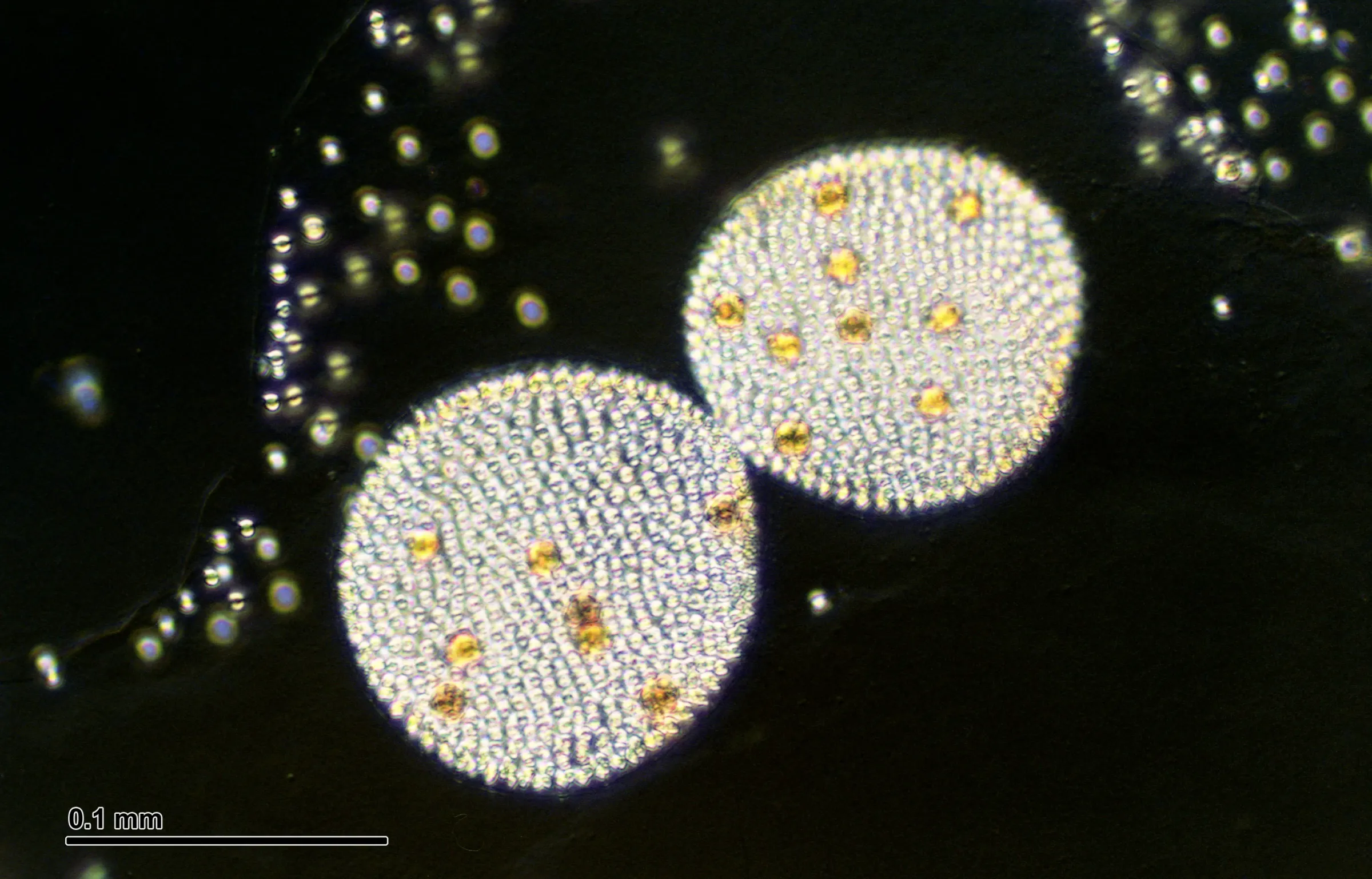
Life as a Double Fixed Point
Living systems are not fixed points in the naive sense but robust attractors and self-reproducing machines, whose encoded description takes part in their own continuation.
On the image Each sphere holds smaller spheres that will become copies of it, built from the instructions it carries. It is a living system that keeps itself intact and reproduces itself at the same time, the double fixed point of the title. Colonies of the green alga Volvox, each carrying daughter colonies inside it, seen through a dark-field microscope. Photo: Josef Reischig, CC BY-SA 3.0, via Wikimedia Commons.
The ladder so far was built from abstract objects: maps, distributions, operators, proofs, programs, and types. Biology is where the abstraction becomes physical. A living organism does more than occupy a state. It is a dynamical system that holds itself inside a viable region of state space while carrying a description that helps reproduce the system itself.
That is why the tempting sentence is:
biology sits at a fixed point.
That is almost right, but the correction matters. Biology does not sit at fixed points. Biology sits on attractors, and in some places it sits near critical points.
The roadmap is:
- define the state space of a body,
- explain why homeostasis is an attracting invariant distribution, not a frozen point,
- explain development as movement through a changing attractor landscape,
- separate the safe claim about biological attractors from the stronger claim about criticality,
- show why life is special: it combines dynamical stability with self-reproduction.
The goal is not to force biology into a metaphor. The goal is to ask a precise question:
what is being kept invariant, by what transformation, and over what time scale?
#The Minimum Vocabulary
A state variable is a quantity used to describe the condition of a system. In physiology, examples include temperature, pH, glucose concentration, hormone levels, membrane voltage, and gene-expression levels.
Homeostasis means keeping a variable inside a viable range. Body temperature is the standard example. The mathematical picture is a stable attractor: perturb the variable and feedback pulls it back.
Allostasis means stability through changing regulation. The target itself can move: cortisol changes over the day, heart rate changes with activity, immune response changes with infection. Life does not always hold one number fixed; often it moves the setpoint while keeping the organism viable.
Feedback means the output of a system affects its future input. Negative feedback damps deviations. Positive feedback amplifies them.
Dissipation means the system continuously loses usable energy to its environment. In dynamical-systems language, dissipation often contracts phase-space volume, pushing trajectories onto lower-dimensional attractors.
An absorbing state is a state that, once reached, cannot be left. For a biological lineage, death and extinction play this role.
Criticality is the boundary where perturbations neither die immediately nor explode without coherence. At criticality, correlations can extend across many scales.
Canalization is developmental robustness. A process is canalized when many small differences in initial condition, noise, or environment still lead to the same functional outcome.
Self-reproduction is not the copying of matter but the copying of a system that contains a description, and the machinery to interpret it.
#The State Space Of A Body
A dynamical system needs a state space. For a body, that sounds impossible at first because the complete state would include every molecule, cell, tissue, signal, microbe, and environmental interaction.
But every model chooses a level of description. If you study thermoregulation, a useful state might include core temperature, skin temperature, metabolic rate, sweat response, and environmental temperature. If you study glucose regulation, the state might include glucose, insulin, glucagon, glycogen stores, food intake, and activity. If you study development, the state might be a vector of gene-expression levels.
So a biological state vector is model-dependent:
$$x_t=(\text{temperature},\text{pH},\text{glucose},\text{hormones},\text{neural activity},\ldots).$$
The dynamics are the rules that move this state forward:
$$x_{t+1}=F(x_t,u_t,\eta_t),$$
where $u_t$ represents inputs such as food, light, stress, infection, or social context, and $\eta_t$ represents noise.
The organism is viable only in a subset of state space:
$$V\subseteq X.$$
Too cold, too acidic, too little ATP, too much inflammation, too much neural excitation: these are exits from viability. Biology is therefore not just a trajectory through state space. It is a trajectory that must remain inside a constrained region while the environment keeps perturbing it.
That is why attractors matter. An attractor is not decorative language. It is the mathematical object that explains how a system can be perturbed and still return to a viable region.
#Attractors, Not Fixed Points
Homeostasis is point-like: temperature, blood pH, osmolarity, glucose regulation. These are variables where variation is dangerous, so feedback loops make the local dynamics contractive.
There is a sharper way to say this using the power-laws essay. A living body is noisy, so the right invariant is rarely a single state. It is a distribution over states that the dynamics leaves unchanged. That is the same object as a Markov stationary distribution $\pi=\pi P$, or the invariant density of a chaotic map: a fixed point of the operator that pushes whole distributions forward one step. Homeostasis is the biological name for an attracting invariant measure, kept narrow by feedback.
But much of life is not point-like. The heartbeat, circadian rhythm, neural oscillations, menstrual cycle, and cell cycle are closer to limit cycles. A limit cycle is not a fixed point of the continuous flow, but it is a fixed point of the return map.
The honest claim is:
living systems sit on robust attractors: point-shaped where nothing should vary, cycle-shaped where something must.
The return-map language is important. Suppose a heartbeat follows a closed orbit in continuous time. Pick a cross-section through that orbit and record where the trajectory returns after one cycle. That gives a discrete map:
$$x_{n+1}=P(x_n).$$
The cycle is stable when the return map has an attracting fixed point:
$$P(x^\star)=x^\star,\qquad |P’(x^\star)|<1.$$
So the first essay’s fixed-point theorem has not disappeared. It has changed level. A rhythm is not a fixed point of the flow, but it is a fixed point of the map that samples the flow once per cycle.
This is the first important connection back to the series. The naive sentence “biology is at a fixed point” is false if it means “the organism is static.” A living body is never static. It breathes, pumps, metabolizes, repairs, learns, and ages.
But the sentence becomes true at the right level:
| Biological phenomenon | Mathematical invariant |
|---|---|
| homeostatic variable | attracting point or narrow invariant distribution |
| heartbeat or circadian rhythm | stable limit cycle / fixed point of a return map |
| cell fate | attractor of a regulatory network |
| tissue identity | basin maintained by feedback and epigenetic regulation |
| reproduction | fixed point of a description-interpreter loop |
Life is not fixed because nothing changes. Life is fixed because some relations survive continuous change.
#Three Forces Push Biology Toward Attractors
First, dissipation. Living systems are open and dissipative. They burn free energy and shed entropy. Dissipation contracts phase-space volume, so trajectories collapse onto lower-dimensional sets.
Second, negative feedback. Insulin and glucagon, thermoregulation, baroreflexes, and many gene-regulatory loops are engineered contractions. Around a viable setpoint, the biology wants something like:
$$|f’(x^\star)|<1.$$
A one-variable caricature makes the point. Let $x_t$ be deviation from a setpoint, such as temperature error. A negative-feedback controller has local form:
$$x_{t+1}=a x_t+\eta_t,$$
where $\eta_t$ is noise. If $|a|<1$, shocks decay geometrically. If $a>1$, shocks amplify. If $a<-1$, correction overshoots so hard that it creates an unstable oscillation. Real physiology is high-dimensional, but the local linear-algebra picture is the same: the eigenvalues of the Jacobian near the viable state must stay inside the unit circle for discrete-time regulation, or have negative real parts for continuous-time regulation.
Third, selection plus death. Death is an absorbing state. A lineage whose vital variables amplify perturbations is removed. We do not observe all possible dynamics. We observe the survivorship-filtered subset that remained inside viable basins of attraction.
This is non-ergodicity in evolutionary form.
The ensemble of possible organisms is enormous. Most architectures do not survive long enough to be sampled through time. The time average over surviving lineages is not the ensemble average over all conceivable biological machines. Selection is not merely optimizing an objective function; it is deleting trajectories that hit the absorbing barrier.
That is why biological stability should not be read as proof of design in the narrow engineering sense. It is often survivorship made visible.
This is the Kelly criterion wearing a lab coat. In simple multiplicative models, a lineage in a fluctuating environment grows, over generations, not at its average fitness but at the geometric mean of fitness across environments, which is the same $\mathbb{E}[\log,\cdot]$ object the ergodicity essay derived for a gambler avoiding ruin. So evolution favors bet-hedging: a genotype that lowers its arithmetic-mean fitness to raise its geometric mean, spreading germination across years or diversifying offspring, can displace a competitor that is better on average but occasionally crashes to zero. The gambler optimizing long-run wealth and the lineage optimizing long-run survival are solving the same log-growth problem in different domains. Non-ergodicity is not a quirk of finance; it is the mathematics of any system that has to keep multiplying through time without hitting zero.
There is a useful linear-algebra summary. Near a viable state $x^\star$, approximate the biological dynamics by its Jacobian:
$$x_{t+1}-x^\star \approx J(x_t-x^\star).$$
If the eigenvalues of $J$ are inside the unit circle, small perturbations shrink. If one eigenvalue crosses outside, perturbations grow along that direction. If a complex pair crosses the stability boundary, oscillations can appear or destabilize.
This is the same local story as the logistic map and the bifurcation essay. Biology adds noise, many dimensions, delays, and changing parameters, but the first diagnostic is familiar: look at the linearized map and ask whether deviations contract.
That also explains why disease is often dynamical rather than merely material. Hypertension, arrhythmia, autoimmune runaway, cancer growth, seizure, chronic inflammation, metabolic syndrome: in each case, a regulatory loop can move from a stable basin into a different attractor or lose stability in a direction that used to contract.
#Development As A Bifurcation Diagram
Cell fates can be understood as attractors of a gene-regulatory dynamical system. Waddington’s landscape is a basin diagram. Kauffman’s random Boolean networks made this precise enough to simulate.
A morphogen gradient is a slowly moving parameter. As the parameter changes, the landscape changes. One progenitor basin can split into two committed-fate basins.
Development is bifurcation theory with chemistry.
In symbols, write gene-expression state as a vector:
$$x_t=(x_t^{(1)},\ldots,x_t^{(n)}),$$
and the regulatory update as:
$$x_{t+1}=F(x_t;r),$$
where $r$ is a developmental parameter: morphogen concentration, position in tissue, time since fertilization, or signaling context. A cell fate is an attractor of $F$. If the underlying chemistry is continuous in time, read $F$ as the return map or sampled update of the regulatory dynamics, the same move used above for heartbeats and cycles. Differentiation is not the cell discovering a label. It is the trajectory falling into a basin as $r$ changes the shape of the state space.
Canalization means the basin is wide. Noise, mutation, and small environmental differences do not immediately kick the cell into the wrong fate. In dynamical language, selection favors attractors with large basins and strong restoring directions for functions that must be reliable.
A tiny one-dimensional landscape makes the bifurcation visible.
Suppose the state of a cell is summarized by one coordinate $x$, and imagine a potential:
$$V(x;r)=x^4-rx^2.$$
The cell tends to roll downhill:
$$\dot{x}=-\frac{dV}{dx}=-4x^3+2rx.$$
When $r<0$, the potential has one minimum at $x=0$. There is one basin. One fate.
When $r>0$, the center becomes unstable and two minima appear:
$$x=\pm\sqrt{\frac{r}{2}}.$$
Now there are two basins. Two fates.
#Simulation: Waddington Landscape
Open this simulation in Explore →
This is not a realistic model of development. It is a clean local picture of what Waddington’s landscape means. A parameter changes. The attractor structure changes. A single valley splits into two. The trajectory does not choose a fate by reading a label; it falls into one basin or the other as the landscape deforms.
In real development, $x$ is high-dimensional. The coordinates are expression levels, chromatin states, signaling pathways, cell-cell interactions, and mechanical constraints. But the dynamical idea is the same:
$$\text{cell fate}=\text{attractor of a regulatory system}.$$
This is where the first two essays return. Development uses fixed points and bifurcations, but not in the toy sense of a single number converging. It uses them in a high-dimensional, noisy, historically constrained state space.
#Criticality
Survival wants deep basins. Computation wants sensitivity.
The variables that must not vary are pinned deep inside attractors. The variables that must process information are often held near criticality, where perturbations propagate without immediately dying and without destroying coherence.
This is the edge-of-chaos idea in biological language:
stable enough to persist, sensitive enough to compute.
Neural avalanches, gene-regulatory networks, immune repertoires, and collective behavior all belong here. Beggs and Plenz, Kauffman, Bialek, Langton, and Bak are all circling the same shape from different sides.
At criticality, a system has no single characteristic scale. Perturbations can remain local, or they can travel across the whole system. Below criticality, signals die too quickly. Above criticality, coherence is destroyed. Near criticality, the system can store information, transmit information, and transform information.
This is the useful meaning of the edge of chaos. Not maximum disorder. Not permanent explosion. The useful region is the boundary where structure persists while remaining responsive.
There are several versions of the claim, and they should not be mixed carelessly.
There is also a live scientific debate here. Criticality is a powerful explanatory frame, but it is not a universal solvent. A power law can come from sampling artifacts, mixtures of hidden variables, optimization under constraints, preferential attachment, or ordinary heterogeneity. Long correlations can be finite-size effects. Neural avalanches can depend on measurement scale and thresholding. So the burden is not merely to point at a broad distribution and say “critical.” The burden is to identify the mechanism, the control parameter, the scaling range, and the alternative explanations.
#Claim 1: Some Biological Systems Show Critical Signatures
This is the most empirical claim, and the most secure. Some biological systems show the textbook measurements of a critical point: power-law avalanches, correlation lengths that grow with the system, scale-free fluctuations, and sharp changes in responsiveness. That these signatures are present is data. What they mean is the contested part, and the contest sharpens with each later claim.
Neural systems are the most famous example. Beggs and Plenz reported neural avalanches whose size distribution is close to the $-3/2$ exponent of a critical branching process. In that model, the key number is the branching ratio. If it is below one, activity dies. If it is above one, activity explodes. Near one, activity propagates without immediately vanishing or saturating. That is exactly the critical boundary.
The branching-process toy model is:
$$Z_{t+1}=\sum_{i=1}^{Z_t} X_i,$$
where $Z_t$ is the number of active units and $X_i$ is the number of descendants triggered by active unit $i$. The branching ratio is:
$$\sigma=\mathbb{E}[X_i].$$
If $\sigma<1$, activity dies out. If $\sigma>1$, activity can blow up. At $\sigma=1$, avalanche sizes follow a power law in the ideal model. This is the simplest mathematical reason critical neural dynamics are interesting: criticality maximizes propagation without immediate runaway.
#Simulation: Branching Criticality
Open this simulation in Explore →
Gene-regulatory systems give a second example. Kauffman’s Boolean-network models have a simple control knob: how many other genes each gene depends on. Too few dependencies and the system freezes. Too many and perturbations spread chaotically. Around the critical regime, often summarized in the toy model as connectivity near $K\approx 2$, the network can remain structured while still adapting.
Collective behavior gives a third example. Bialek and collaborators argued that starling flocks sit near a ferromagnetic-style critical point: directional correlations can extend across the whole flock instead of dying at a fixed distance. The flock behaves less like a crowd of independent birds than like a correlated system whose correlation length scales with its size.
The immune system gives a fourth example. Antibody affinity, T-cell receptor diversity, and immune repertoire statistics often show broad, heavy-tailed structure. The cautious claim is not that every such distribution proves a critical point. The useful claim is that immune adaptation lives in the same tradeoff: enough stability to remember, enough sensitivity to respond to unknown perturbations.
#Claim 2: Criticality Is Computationally Useful
This is a model claim. It says that systems near the ordered-chaotic boundary can process information better than systems deep in either regime.
Langton made the computational version precise for cellular automata. His $\lambda$ parameter moves systems from frozen order to chaotic disorder. The interesting computational region lies near the edge, where information can be stored, transmitted, and transformed. This is the cleanest theoretical version of the biological intuition: the edge of chaos is not aesthetic language; it is where computation becomes possible.
The intuition is simple. In a frozen system, perturbations vanish too fast. Nothing propagates. In a chaotic system, perturbations spread too fast and destroy usable structure. Near the boundary, signals can travel, interact, and still remain interpretable.
In linear terms, think again about eigenvalues. If every direction contracts strongly, the system forgets too much. If many directions expand strongly, the system becomes unstable. Near marginal stability, where important directions are close to the boundary, perturbations can persist long enough to carry information.
That does not mean every variable should be marginal. Core pH should not live at the edge of chaos. Neural and immune variables may. The body is not one dynamical regime. It is a hierarchy: some variables are pinned, some oscillate, some adapt, and some compute near critical boundaries.
#Claim 3: Evolution May Self-Organize Near Criticality
This is the broadest claim, and the one to hold at arm’s length. It says evolution does not merely produce local attractors but actively tends to park adaptive systems near critical points, because that is where large reorganizations stay possible.
The picture is genuinely attractive. In Bak’s sandpile, the pile is not waiting for one final avalanche; it maintains a slope on which avalanches of every size remain possible. Read evolutionary history in that language and the major transitions, autocatalytic chemistry, prokaryote to eukaryote, unicellular to multicellular, asexual to sexual, organism to superorganism, look like avalanches in a self-maintained critical landscape. Punctuated equilibrium fits the same frame: long stasis is the system resting in a basin, and the punctuations are jumps between basins. Kauffman’s autocatalytic sets supply a candidate mechanism for one such jump. Below a catalytic-density threshold there is chemistry but no self-sustaining closure; above it, a reflexively autocatalytic network maintains itself, a phase transition into a new attractor of organization.
But attractive is not established, and this is the place the series is most likely to overspend its credibility. This rung rests more on analogy than on measurement, so the honest move is to name exactly where the evidence is thin rather than soften every sentence around it:
- The neural-avalanche exponent is contested. Subsampling a network that is not actually critical can manufacture a clean $-3/2$ power law, and some cortical recordings fit a slightly subcritical, reverberating regime better than a critical one.
- $K\approx 2$ is the critical connectivity of a toy random Boolean network. That real gene-regulatory networks sit at that boundary is a separate claim, with far weaker support than the tidy number implies.
- Self-organized criticality as a theory of evolution, the Bak-Sneppen line, is largely a metaphor. The model shows that a toy fitness-replacement rule can self-organize to criticality; it does not show that real evolution, with ecology, development, population structure, and changing environments, does the same. Its grounding in the fossil and genomic record is therefore much thinner than the toy model makes it feel.
- The scale-free correlations measured in starling flocks are real and striking; reading them specifically as criticality, rather than as one of several models that produce long correlations, is the step in dispute.
None of this is a debunking. Criticality remains a productive lens, and Claims 1 and 2 stand on their own. But “evolution aims at the edge of chaos” is a hypothesis wearing the costume of a law, and it should be worn loosely.
What survives every one of these doubts is a weaker, sturdier statement, and it is the one to actually stand behind:
biological systems are often organized so that vital variables sit in robust basins, while adaptive and informational variables sit closer to marginal stability.
That allocation claim asks for no commitment to self-organized criticality as a biological law. It needs only what the earlier essays already earned: feedback makes some directions contract hard, and selection deletes the lineages whose vital variables do not. It also rules out the sloppy version,
life is chaos.
Life is not chaos. Chaos destroys an organism the moment it reaches the wrong variable. The defensible claim is only that living systems allocate stability and sensitivity differently across scales.
#What Is Being Fixed?
At this point the word “fixed” can mislead.
The fixed object is not a frozen organism. It is a pattern of recurrence across time scales.
At the fast physiological scale, variables return to viable ranges:
$$x_t\in V.$$
At the developmental scale, cells fall into reproducible fate basins:
$$x_{t+1}=F(x_t;r)\longrightarrow A_r.$$
At the evolutionary scale, lineages that leave viability disappear:
$$\text{trajectory hits death}\Rightarrow\text{removed from future sampling}.$$
At the reproductive scale, the description-interpreter loop repeats:
$$C(G,E)\longrightarrow (C’,G’).$$
These are different invariants. Confusing them makes the thesis vague. Keeping them separate makes the thesis stronger: biology is not one fixed point, but a stack of invariant structures that operate at different time scales.
#Life As A Double Fixed Point
Life is where the two engines meet.
Engine A drags the organism onto dynamical attractors: homeostasis, rhythms, development, tissue identity.
Engine B appears because DNA is self-description embedded inside the system that reads and copies it. A cell contains both a description and the machinery that interprets the description.
In rough form:
$$\operatorname{eval}(\text{genome}) \approx \text{organism containing genome}.$$
That is not a casual metaphor. It is the biological version of the self-reproduction problem studied by von Neumann: tape plus universal constructor. The genome is not the organism, just as a program is not the machine executing it. But the organism contains machinery that reads the genome, constructs the proteins that maintain the machinery, and reproduces the genome into the next system.
A more careful schematic is:
$$C(G,E)\longrightarrow (C’,G’),$$
where $G$ is the genome, $C$ is the cellular machinery, and $E$ is the environment. Reproduction succeeds when:
$$G’\approx G$$
and the new machinery $C’$ can read $G’$ again. The fixed point is therefore not a static object. It is a closed reproductive loop: description produces interpreter, interpreter copies description, and the resulting system can repeat the loop.
Life is a self-describing system that is also a stable attractor of its own dynamics.
That is the double fixed point:
- Dynamically, the organism survives by remaining inside viable attractors.
- Recursively, the organism reproduces by carrying an encoded description that participates in constructing another system carrying the description.
The deep fact about life is not merely that it is stable. Many dead systems are stable. The deep fact is that stability and self-description coincide.
The caveat is important. DNA is not a blueprint in the naive sense. A blueprint can be read by an external builder. A genome is read by machinery that is itself partly produced under genomic control and partly inherited from the previous cell. The interpreter is not outside the system.
That is why the better analogy is not blueprint but quine-like loop.
A quine works because code and interpreter cooperate. A genome works because genome, ribosome, membranes, enzymes, cellular architecture, and environment form a closed enough loop to produce another loop of the same kind.
This is where biology is deeper than ordinary dynamical stability. A whirlpool is an attractor, but it does not encode a description that helps produce future whirlpools. A crystal can replicate structure, but it does not contain an internally interpreted program for building the machinery that continues the process. Life combines:
- attractor structure,
- metabolism and dissipation,
- inherited description,
- an interpreter for that description,
- reproduction of both description and interpreter.
That combination is why life belongs after the self-reference essay. It is more than an example of Engine A: it is the first real-world system in the series where Engine A and Engine B visibly cooperate.
The most precise final statement is:
a living system is a dissipative attractor that carries an encoded description participating in the reproduction of another dissipative attractor of the same kind.
The twelfth lesson:
Life is a double fixed point: a dissipative attractor that also encodes and reproduces the description needed to rebuild itself.
That sentence is less romantic than “life is a fixed point,” but it is closer to the mathematics.
The invariant summary of this essay is:
$$ x_t\in V $$
for fast viable physiological variables;
$$ x_{t+1}=F(x_t;r)\longrightarrow A_r $$
for development and fate basins; and
$$ C(G,E)\longrightarrow(C’,G’),\qquad G’\approx G $$
for reproduction. Life is where those invariants coexist: a body must remain in viable attractors while carrying an internal description that helps produce another viable body.
#Further Reading
- Stuart Kauffman, The Origins of Order. Attractors, Boolean networks, autocatalysis, and self-organization in biology.
- C. H. Waddington, The Strategy of the Genes. The source of the developmental landscape metaphor.
- John Beggs and Dietmar Plenz, Neuronal avalanches in neocortical circuits (2003). The neural criticality reference.
- William Bialek et al., Statistical mechanics for natural flocks of birds (2012). Scale-free correlations in collective behavior.
- John von Neumann, Theory of Self-Reproducing Automata. The computational ancestor of the genome-as-description story.
- Per Bak, How Nature Works. The popular route into self-organized criticality.
From the series When Rules Repeat: The Fixed Point Ladder.
Written with an LLM in the loop, like everything here. The ideas and the mistakes are mine. More on how I write.