
Fixed Points and Attractors
The foundation of the ladder: repeated rules, dynamical systems, fixed points, attractors, basins, bifurcations, Newton iteration, and the logistic map.
On the image As the Earth turns, every star in a long exposure draws an arc around a single point that does not move. The whole sky is transformed and one point is left where it was, which is what a fixed point is. Star trails circling the celestial pole above Kitt Peak National Observatory, Arizona, 2025. Photo: DESI Collaboration/DOE/KPNO/NOIRLab/NSF/AURA/L. Tyas, CC BY 4.0, via Wikimedia Commons.
Start with something small: a number, a rule, and the patience to apply the rule again.
What happens when you repeatedly apply a rule?
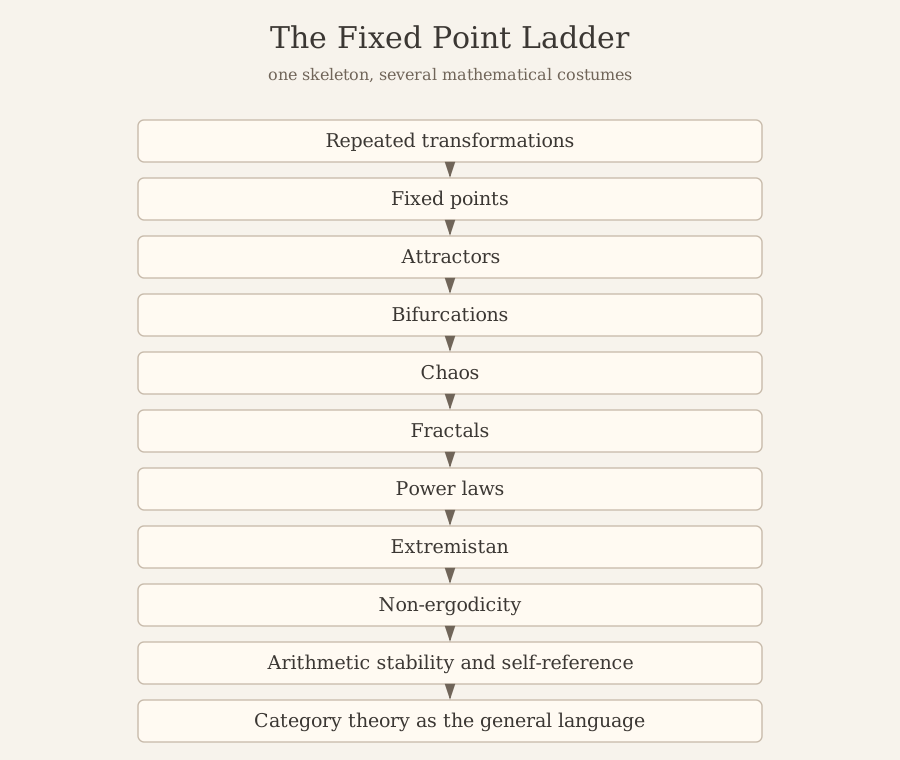
That question is small enough to fit into a first course in analysis, but it opens into a surprising amount of modern mathematics. A repeated rule can settle into a fixed point. A fixed point can become an attractor. An attractor can split. Repeated splitting can become chaos. Chaos can leave behind fractal geometry. Fractal geometry can show up statistically as power laws. Power laws can make averages unstable. Once time and recurrence matter, number theory enters. Once a system can encode and act on itself, logic and computation enter. Once you want the same pattern without caring whether the objects are numbers, programs, proofs, or types, category theory enters.
I will keep the level deliberately concrete. Whenever a bigger word appears, the word should earn its keep.
#The Minimum Vocabulary
A dynamical system is a system whose state changes according to a rule.
The state is the information you need in order to know where the system is. For a one-dimensional example, the state might be a single number $x$. For a planet, the state might include position and velocity. For a market, it might include prices, inventories, leverage, and beliefs. For a program, it might include memory, registers, and input.
The set of all possible states is called the state space.
If time moves in discrete steps, the rule usually looks like:
$$x_{n+1}=f(x_n).$$
Read this as:
the next state equals a function of the current state.
The sequence:
$$x_0,x_1,x_2,x_3,\ldots$$
is called the orbit or trajectory of the starting point $x_0$.
So the whole question becomes:
If I start here and keep applying the same function, where does the orbit go?
That is all a discrete dynamical system is.
If time is continuous instead, the rule is usually written as a differential equation:
$$\frac{dx}{dt}=F(x).$$
Read this as:
the velocity of the state is determined by the current state.
This article mostly uses the discrete version because it is easier to see the fixed-point structure. But the same ideas apply to differential equations.
#Repetition Creates Fixed Points
Start with the simplest possible dynamical system:
$$x_{n+1} = f(x_n).$$
You choose an initial condition $x_0$, apply the rule once, get $x_1$, apply the same rule again, get $x_2$, and keep going. Eventually one of three things can happen:
- the sequence converges,
- the sequence cycles,
- the sequence becomes chaotic.
The cleanest case is convergence. Take:
$$f(x)=\frac{x+1}{2}.$$
The fixed point is the value $x^\star$ satisfying:
$$x^\star = f(x^\star).$$
So:
$$x^\star = \frac{x^\star+1}{2}$$
and therefore:
$$x^\star = 1.$$
The star in $x^\star$ is just notation. It means “the special value we are solving for.” Nothing mystical.
What matters is not that $1$ solves the equation, but that every starting point gets pulled there. If $e_n=x_n-1$ is the distance from the fixed point, then:
$$e_{n+1}=\frac{x_n+1}{2}-1=\frac{x_n-1}{2}=\frac{e_n}{2}.$$
So the error halves every step:
$$e_n = 2^{-n}e_0.$$
That is a contraction. A contraction is a function that always brings points closer together. If two inputs are one unit apart, their images might be only half a unit apart. Apply the function again and they are a quarter unit apart. Keep going and the distance collapses.
Banach formalized the general theorem: if a map brings points closer together in a complete metric space, repeated application converges to a unique fixed point.
The theorem is worth stating because it is the cleanest version of the whole ladder.
Let $(X,d)$ be a complete metric space, and let $f:X\to X$ satisfy:
$$d(f(x),f(y))\leq q,d(x,y)$$
for every $x,y\in X$ and some constant $0<q<1$. Then there exists a unique fixed point $x^\star$ such that:
$$f(x^\star)=x^\star,$$
and for every starting point $x_0$:
$$x_n=f^n(x_0)\to x^\star.$$
Here is the notation unpacked:
- $X$ is the state space.
- $d(x,y)$ is the distance between two states.
- Complete means Cauchy sequences actually converge inside the space. For this essay, you can think “no missing limit points.”
- $f^n(x_0)$ means apply $f$ repeatedly $n$ times.
- $q<1$ is the contraction factor.
The proof is the mechanism. Successive iterates form a Cauchy sequence because the jumps shrink geometrically:
$$d(x_{n+1},x_n)\leq q^n d(x_1,x_0).$$
Completeness says the sequence has a limit. Continuity of $f$ says the limit must satisfy $f(x^\star)=x^\star$. The contraction inequality says there cannot be two such points, because if $x^\star$ and $y^\star$ were both fixed:
$$d(x^\star,y^\star)=d(f(x^\star),f(y^\star))\leq qd(x^\star,y^\star),$$
which is impossible unless the distance is zero.
This is the basic fixed-point machine: contraction plus completeness produces existence, uniqueness, and convergence. Later the same pattern gets harder to recognize because the space is no longer a line. It might be a space of functions, proofs, programs, measures, or types. But the question stays the same: what operation is being repeated, and what does it leave invariant?
Banach is not the only fixed-point theorem. It is just the cleanest one to start with because the mechanism is visible: distances shrink.
There are other families:
- Brouwer fixed points. A continuous map from a disk to itself has a fixed point. No contraction is required. This is the topological theorem behind many equilibrium arguments.
- Kakutani fixed points. A set-valued version of Brouwer. This is one route to Nash equilibria in game theory.
- Knaster-Tarski fixed points. A monotone function is one that preserves order: if $a\leq b$, then $f(a)\leq f(b)$. On a complete lattice, meaning an ordered collection where every subcollection has a least upper bound and a greatest lower bound, such a function has least and greatest fixed points. This is fundamental in logic, semantics, and recursive definitions.
- Kleene fixed points. Under continuity conditions on ordered spaces, the least fixed point can be built by iterating from the bottom element.
These theorems differ in what kind of structure they require: metric contraction, topology, convexity, or order. But they all answer the same question: when is a rule forced to leave something unchanged?
The order-theoretic case returns later as the notation $\mu F$: the least fixed point of a functor or type constructor. In programming-language semantics, a recursive datatype is built by iterating from the empty approximation upward, exactly the Kleene picture in a different category.
One familiar application is PageRank. A web-surfer distribution is repeatedly multiplied by a transition matrix. The ranking is the stationary vector:
$$\pi=\pi P.$$
That is a fixed point. Google’s original insight was not only “links are votes”; it was that importance can be defined as the stable distribution of a repeated navigation process.
#Simulation: Contraction
Open this simulation in Explore →
The whole phenomenon fits in a few lines:
def iterate(f, x0, n=20):
    xs = [x0]
    for _ in range(n):
        xs.append(f(xs[-1]))
    return xs

f = lambda x: (x + 1) / 2
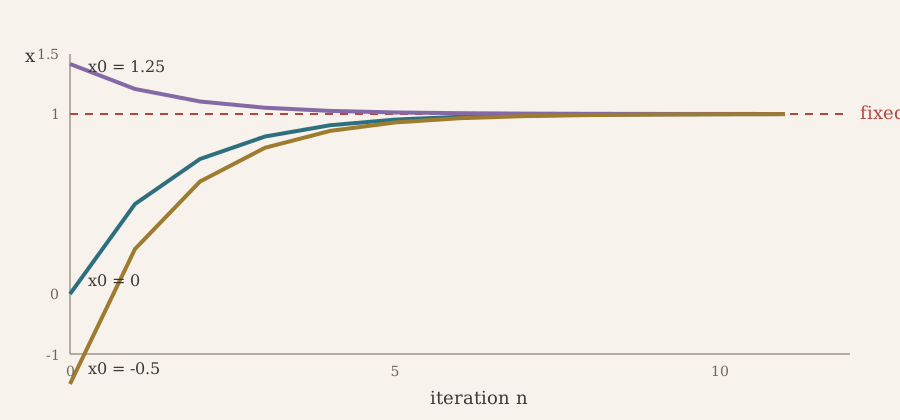
paths = [iterate(f, x0) for x0 in [-0.5, 0.0, 1.25]]
Plot those paths. Every one collapses onto $1$. The rule acts repeatedly, and repetition reveals the fixed point.
#Newton’s Method: Practical Fixed-Point Iteration
The contraction example is deliberately simple. A more practical fixed-point iteration is Newton’s method.
Suppose you want to solve:
$$g(x)=0.$$
Newton’s method replaces the equation with an iteration:
$$x_{n+1}=x_n-\frac{g(x_n)}{g’(x_n)}.$$
Define:
$$N(x)=x-\frac{g(x)}{g’(x)}.$$
Then Newton’s method is:
$$x_{n+1}=N(x_n).$$
A root of $g$ is a fixed point of $N$, because if $g(x^\star)=0$, then:
$$N(x^\star)=x^\star.$$
When Newton’s method works well, it converges extremely fast. Near a simple root, the error squares at each step. This is called quadratic convergence.
But Newton’s method also foreshadows fractals. In the complex plane, if a polynomial has several roots, each starting point flows toward one of them. Color each initial point by the root it reaches. The basins of attraction often have fractal boundaries. Newton fractals tie together fixed points, attractors, basins, and fractal geometry in one practical algorithm.
A modern version of the same idea is gradient descent:
$$x_{n+1}=x_n-\eta\nabla L(x_n).$$
The rule moves downhill on a loss landscape. Fixed points satisfy:
$$\nabla L(x^\star)=0.$$
So local minima, saddle points, and flat critical regions are fixed points of the optimization dynamics. This is one reason the language of stability, basins, and attractors shows up naturally in machine learning.
The first lesson:
Repeated transformations create fixed points.
Before moving on, notice something subtle. The fixed point is not an extra object imported from outside the system. It is produced by the rule itself. You do not choose $1$ as the destination for $f(x)=(x+1)/2$. The rule chooses it. This matters because every later example follows the same pattern. The long-run object is not separately designed. It is the invariant object exposed by repetition.
#Fixed Points Create Attractors
Now stop thinking about isolated numbers and think geometrically.
Imagine a state space. A point moves through it. The rule tells it where to go next. Instead of a number being updated by a formula, imagine a marble rolling on a landscape.
The valleys are attractors.
An attractor is a long-run destination for many starting points.
A fixed point is the static equation:
$$f(x)=x.$$
An attractor is the dynamic limit:
$$f^n(x)\to A.$$
This notation means: apply $f$ to $x$ again and again, and the result approaches the set $A$.
The first statement says a point stays still when the rule is applied. The second says a whole region of starting points eventually gets pulled into the same structure.
That structure does not have to be a single point. It can be:
- a point attractor,
- a periodic orbit,
- a strange attractor.
The fixed point is the smallest member of a larger family. It is an attractor with no internal motion.
The extra object you need is the basin of attraction:
$$B(A)={x\in X:\operatorname{dist}(f^n(x),A)\to 0}.$$
This formula says: the basin of $A$ is the set of starting points that eventually get pulled into $A$.
This set is often more important than the attractor itself. It tells you which initial conditions end up in the same long-run regime. In a system with one basin, prediction is mostly about speed of convergence. In a system with several basins, prediction becomes about boundaries. A tiny perturbation near a basin boundary can send the same system into a different future.
That is why attractors are already political, economic, and psychological objects, not just mathematical ones. A habit, a market regime, a cultural equilibrium, a protocol standard, a language ecosystem, a personal addiction, all can be understood as basins. More than a destination, the attractor is what pulls many different histories into the same shape.
This also explains why “fixed point” is too small a phrase for many real systems. A society may never settle to one literal state. A market never stops moving. A mind never freezes. But the trajectory can still be confined to a region, a style, a recurring pattern. The fixed point has become an invariant form of motion.
The second lesson:
Attractors are fixed points viewed dynamically.
The bridge from fixed points to attractors is the bridge from algebra to geometry.
Algebra asks:
$$f(x)=x.$$
Geometry asks:
$$f^n(U)\to A,$$
where $U$ is a whole region of initial conditions.
Those are different questions. The first question identifies a point. The second identifies the long-run fate of a neighborhood. A fixed point can exist algebraically and still be dynamically irrelevant. If nearby points move away from it, then the point solves the equation but does not explain the behavior of the system.
This is the first major upgrade in the ladder. We stop asking only whether an invariant object exists and start asking whether the surrounding space is organized by that object. In analysis, the fixed point is a solution. In dynamics, the fixed point becomes a force field around a solution. The equation is still there, but now the real object is the basin: the set of histories that end up sharing the same fate.
So after fixed points, the next natural question is not “what solves $f(x)=x$?” but “what pulls nearby points toward it?”
#Parameters Create Bifurcations
Now introduce a parameter.
Instead of one rule, consider a family of rules:
$$x_{n+1}=f_r(x_n).$$
The parameter $r$ is just a knob. Change the knob and you change the rule. In a population model, $r$ might be the growth rate. In physics, it might be temperature. In markets, it might be leverage or liquidity. In a neural system, it might be coupling strength.
The parameter changes the landscape. Sometimes this only moves the valley. Sometimes it changes the number of valleys.
Before:
\__/After:
\_/ \_/That is a bifurcation. One future becomes two possible futures.
A bifurcation is a qualitative change in the long-run behavior of a system as a parameter changes. Not a small numerical change. A structural change.
The logistic map is the canonical classroom example:
$$x_{n+1}=r x_n(1-x_n).$$
Slow down here: the logistic map is the miniature version of the whole series.
The variable $x_n$ is usually interpreted as a normalized population at time $n$, so $0\leq x_n\leq 1$. The parameter $r$ is the growth rate. The term $rx_n$ says the population grows proportionally to its current size. The term $(1-x_n)$ says growth is limited by crowding. When $x_n$ is small, $1-x_n$ is close to $1$, so growth is easy. When $x_n$ is close to $1$, $1-x_n$ is close to $0$, so growth is suppressed.
So the logistic map is a competition between two forces:
- amplification: $rx_n$,
- saturation: $1-x_n$.
That is why it bends downward. It is not a straight line. It is a hump.
This hump matters. Linear maps can converge or diverge, but they cannot create the full period-doubling route to chaos. The logistic map can because it expands some regions, folds the interval back into itself, and keeps everything bounded inside $[0,1]$ when $0\leq r\leq 4$.
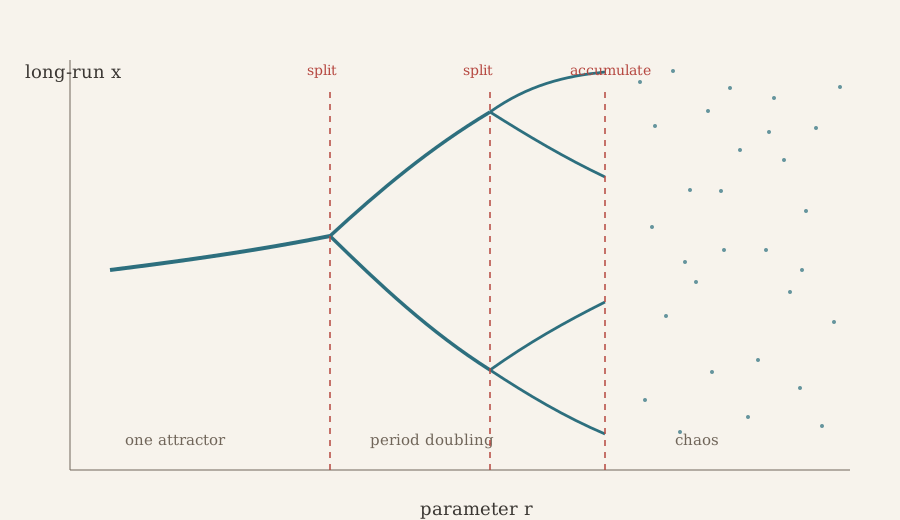
For small $r$, the system converges to one fixed point. Increase $r$, and the fixed point loses stability. A period-two cycle appears. Increase $r$ again, and the period-two cycle splits into a period-four cycle. Then period eight. Then sixteen.
The system is not merely moving around inside the same landscape. The landscape itself is changing.
You can see the first split analytically. For the logistic map:
$$f_r(x)=rx(1-x),$$
the nonzero fixed point is:
$$x^\star = 1-\frac{1}{r}.$$
A fixed point is locally stable when:
$$|f_r’(x^\star)|<1.$$
This condition comes from first-year analysis. Near a fixed point, the function is approximately linear:
$$f(x^\star+h)\approx f(x^\star)+f’(x^\star)h.$$
Since $f(x^\star)=x^\star$, the error after one step is approximately:
$$h_{n+1}\approx f’(x^\star)h_n.$$
If $|f’(x^\star)|<1$, the error shrinks. If $|f’(x^\star)|>1$, the error grows. That is local stability.
Since:
$$f_r’(x)=r(1-2x),$$
we get:
$$f_r’(x^\star)=r\left(1-2\left(1-\frac{1}{r}\right)\right)=2-r.$$
So stability requires:
$$|2-r|<1,$$
or:
$$1<r<3.$$
At $r=3$, the fixed point loses stability. The system does not simply become noisy. A new stable object appears: a period-two orbit. The fixed point remains algebraically present, but it no longer attracts. The future has changed because the attractor structure changed.
That sentence is the key. The old fixed point does not disappear. It loses stability. The map still has the solution $x^\star=1-1/r$, but nearby points no longer settle there. They bounce around it. Stability has moved from a point to a cycle.
A period-two orbit is a pair of points $a,b$ such that:
$$f_r(a)=b,\qquad f_r(b)=a.$$
Equivalently:
$$f_r^2(a)=a.$$
So a period-two orbit is a fixed point of the second iterate $f_r^2$, not of $f_r$ itself. A period-four orbit is a fixed point of $f_r^4$. A period-eight orbit is a fixed point of $f_r^8$.
This is why period doubling belongs in a fixed-point essay. The system keeps creating fixed points of higher iterates:
$$f_r^{2^k}(x)=x.$$
The attractor is no longer a point in the original one-step dynamics, but it is still a fixed point when viewed at the right time scale. The only thing that changed is the level at which you look.
This also prepares the connection to fractals. Each time the period doubles, the graph of the long-run states branches. Zoom into the bifurcation diagram near the onset of chaos and the same pattern reappears: branches split into smaller branches, which split into smaller branches, with ratios controlled by Feigenbaum’s constants. The bifurcation diagram is more than a plot; it is a self-similar object generated by repeated composition of the same map.
#Simulation: Stability Derivative
Open this simulation in Explore →
Let the reader move $r$ and show the fixed point:
$$x^\star=1-\frac{1}{r}.$$
Next to it, show:
$$|f_r’(x^\star)|=|2-r|.$$
The important moment is:
$$|f_r’(x^\star)|=1$$
at:
$$r=3.$$
import numpy as np
import matplotlib.pyplot as plt

r = np.linspace(1.1, 4.0, 500)
x_star = 1 - 1 / r
stability = np.abs(2 - r)

fig, ax = plt.subplots(2, 1, sharex=True)
ax[0].plot(r, x_star)
ax[0].set_ylabel("fixed point")

ax[1].plot(r, stability)
ax[1].axhline(1, color="black", linestyle="--")
ax[1].axvline(3, color="red", linestyle="--")
ax[1].set_xlabel("r")
ax[1].set_ylabel("|f'(x*)|")
plt.show()
What the reader should see: the fixed point does not disappear at the first bifurcation. It loses stability. The attractor moves from a point to a cycle.
#Simulation: Cobweb Diagram
Open this simulation in Explore →
The cobweb diagram is the standard picture for a one-dimensional map. Draw the curve $y=f(x)$ and the diagonal $y=x$. Starting from $x_0$, move vertically to the curve, then horizontally to the diagonal. That horizontal move turns the output $f(x_0)$ into the next input $x_1$. Repeating the staircase shows convergence, cycling, or instability.
#Simulation: Logistic Bifurcation
Open this simulation in Explore →
import numpy as np
import matplotlib.pyplot as plt

rs = np.linspace(2.5, 4.0, 2000)
xs_r = []
ys = []

for r in rs:
    x = 0.5
    for _ in range(1000):
        x = r * x * (1 - x)
    for _ in range(200):
        x = r * x * (1 - x)
        xs_r.append(r)
        ys.append(x)

plt.plot(xs_r, ys, ",", color="black", alpha=0.35)
plt.xlabel("r")
plt.ylabel("long-run x")
plt.show()
The third lesson:
Bifurcations change the attractor structure.
The bridge from attractors to bifurcations is the parameter.
A parameter turns one dynamical system into a family of dynamical systems. That sounds innocent, but it changes the question completely. With one system, you ask what the attractors are. With a family of systems, you ask how the attractors are born, move, split, collide, and disappear as the parameter changes.
This is where stability becomes historical. A fixed point may be stable today and unstable tomorrow because a parameter crossed a threshold. The point did not vanish as a solution; it lost its authority over nearby trajectories. That loss of authority is exactly what a bifurcation records.
This is why bifurcation theory is not interested in every small numerical change. If a fixed point moves from $0.41$ to $0.42$, the system changed quantitatively. If one attracting fixed point becomes an attracting two-cycle, the future changed qualitatively. The map of possible futures changed its topology.
The conceptual move is:
$$\text{long-run destination} \quad\longrightarrow\quad \text{change in the set of destinations}.$$
That move is what lets the essay pass from convergence to chaos. Chaos does not arrive from nowhere. It arrives because the attractor structure keeps changing.
The invariant summary of this essay is:
$$ x_{n+1}=f(x_n) $$
creates the first fixed-point question:
$$ f(x^\star)=x^\star. $$
But the real dynamical question is larger:
$$ f^n(x_0)\longrightarrow A, $$
where $A$ may be a point, a cycle, a basin, or a more complicated attractor. Parameters then change $A$. That is the doorway to the next essay: bifurcations, chaos, and fractal invariant sets.
#Further Reading
- Steven Strogatz, Nonlinear Dynamics and Chaos. The best first book for fixed points, stability, bifurcations, and the logistic map.
- Robert May, Simple mathematical models with very complicated dynamics (1976). The classic short paper that made the logistic map famous outside pure dynamics.
- James Munkres, Topology. Useful background for Brouwer-style fixed-point thinking.
- Alfred Tarski, A lattice-theoretical fixpoint theorem (1955). The source for Knaster-Tarski fixed points.
- Heinz-Otto Peitgen and Peter Richter, The Beauty of Fractals. A visual route into Newton fractals and basins of attraction.
- Henri Poincaré, Science and Method (1908). Where dynamical-systems thinking and sensitive dependence on initial conditions begin: small differences in the initial conditions producing very great ones in the final phenomena.
From the series When Rules Repeat: The Fixed Point Ladder.
Written with an LLM in the loop, like everything here. The ideas and the mistakes are mine. More on how I write.