The Death of the Inner Self
Individuality is a coordination technology. It emerged under specific historical conditions, and those conditions are weakening as computation, capital, and automated feedback loops absorb the functions it once performed.
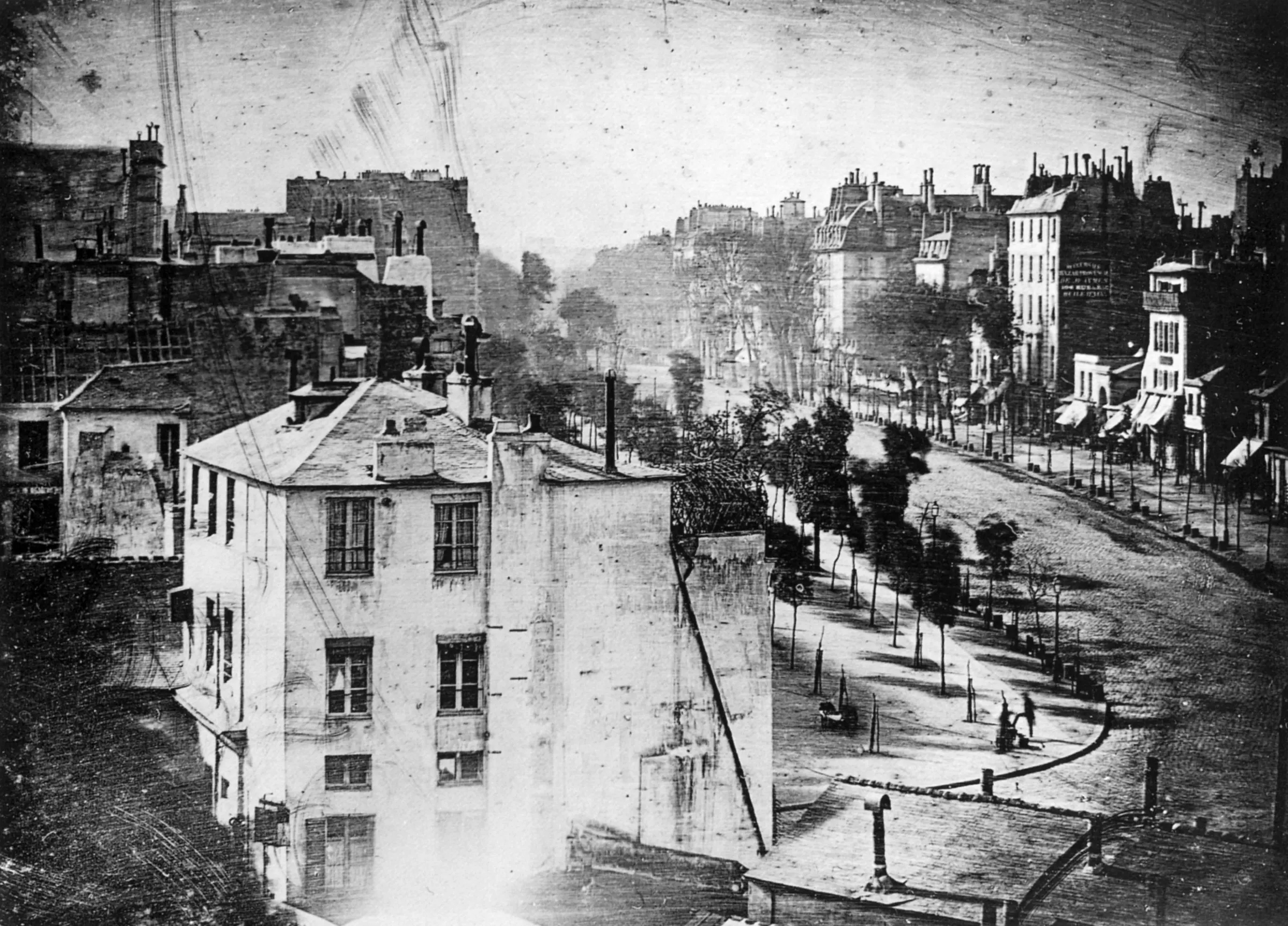
On the image The exposure lasted several minutes, so the moving traffic left no trace and only a man standing still to have his boots polished was recorded. A self shows up where something holds still long enough to register. Boulevard du Temple, Paris, 1838, a daguerreotype and the earliest known photograph of a person. Photo: Louis Daguerre, public domain, via Wikimedia Commons.
The core argument is simple: many features of human life that appear stable and natural are historically produced. As society accelerates, a number of these features begin to lose their function and their permanence. I believe consciousness as we know it is one of them.
#Individuality as technology
Life is organized around information that replicates under constraint. Computation generalizes this biological logic. It allows selection and optimization to occur faster and at larger scales by externalizing memory, comparison, and feedback. Problems that once required internal deliberation can be solved through external processes that test, filter, and iterate possibilities.
Capital pushes this logic further. It reorganizes social life around continuous feedback, price signals, and competitive selection. As these forces compound, individuality starts to look less like a foundation and more like an interface that emerged to solve earlier coordination problems.
Capital behaves as an impersonal intelligence oriented toward speed, abstraction, and self-optimization. As cognition, decision-making, and coordination migrate into automated systems, the inner self loses its structural role. Over time, many assumptions we take for granted are worn down by this acceleration. Individuality and consciousness appear increasingly exposed to this process.
#The construction we cannot see
Fish do not realize they live in water. The medium that sustains them is so constant that it disappears from perception. Some of the most important structures are overlooked for the same reason. Individuality and consciousness belong to that category.
We tend to treat individuality and consciousness as self-evident facts, as if humans have always experienced themselves as bounded selves with an inner voice, a private mental space, and a continuous narrative identity. Because this experience feels natural, it is assumed to be timeless. Serious thinkers have argued it is not. Julian Jaynes pointed out that the heroes of the Iliad show almost no inner mental space, hearing the voices of gods where we would hear our own deliberation. Charles Taylor traced how the modern “buffered self,” sealed inside its own mind, was assembled over centuries out of religious and philosophical practice, displacing an older “porous self” open to forces from outside. For most of human history people did not describe themselves as individuals in the modern sense. Decisions were not understood as outcomes of inner deliberation, and agency was not located inside a private interior self. Action was organized through rituals, traditions, kinship, and prescribed roles. Meaning arrived from outside the person rather than from introspection. In many societies outside the Western trajectory, this structure remains largely intact.
The idea of a you inside your head observing your own thoughts is therefore a learned construction. It depends on language, habits, metaphors, and social practices that had to be developed and stabilized over time. Lev Vygotsky argued that inner speech is not innate but internalized social speech: children first talk to others, then to themselves aloud, then silently, until the dialogue goes underground and starts to feel like the private voice of a self. Narrative memory, moral self-examination, and the sense of authorship over action emerged the same way, as cultural achievements layered on top of older biological processes.
Modern societies actively reproduce this configuration. From early childhood, people are trained to understand themselves as autonomous units with opinions, preferences, goals, and an inner life that belongs only to them. The training is so pervasive that it becomes invisible. Other ways of being human recede from view, even though many have existed and some still persist.
#The weakening of the conditions
The conditions that once made individuality functional are weakening. Earlier systems relied on human subjects to think, decide, judge, and take responsibility. Cognition and coordination were constrained by human minds. Individuality emerged as a solution: a stable self enabled long-term planning, moral accounting, and institutional continuity.
Earlier societies coordinated without modern consciousness. Contemporary systems increasingly coordinate without modern selves. Decision-making proceeds without inner deliberation. Meaning is delivered through incentives, metrics, and feedback loops.
At the cultural level, individuality remains constantly invoked. People are urged to be themselves, express themselves, optimize themselves. Yet the channels for expression arrive pre-shaped, quantified, and monetized. What appears as selfhood increasingly takes the form of managed performance within narrow bounds.
#Replacement by degrees
The modern self does not collapse in a single moment. It is replaced function by function, each substitution small enough to go unnoticed.
Taste was once formed through a slow, private process: encountering things by accident, sitting with discomfort, learning to love what initially resisted you. Algorithmic recommendation compresses this into a profile that updates in real time. The system knows what you will like before you do. The inner process of forming a preference, the hesitation, the revision, the gradual shaping of sensibility, loses its purpose when an external system performs it faster and with better accuracy. What remains looks like taste but functions as consumption.
Judgment follows a similar path. In organizations that once depended on accumulated experience, performance metrics now determine what counts as competent work. The slow formation of professional intuition, the kind that takes years to develop and resists easy articulation, gets flattened against quarterly targets. This is Goodhart’s law turned structural: once a measure becomes the target it stops measuring what it was meant to, and here the target gradually replaces the faculty it was only ever a proxy for. When the metric becomes the institution’s memory of what the work is for, the judgment it was meant to approximate quietly disappears. People still show up. They optimize what is measured. The rest erodes.
Inner deliberation faces the same pressure from a different direction. When an AI assistant can draft your emails, plan your week, summarize your reading, and suggest your next decision, the internal process of thinking through a problem starts to feel unnecessary, not wrong exactly, just slow. The assistant never tells you to stop thinking; it just makes thinking feel like friction in a system that rewards speed. Over time, the habit of sustained internal reflection weakens for the same reason any unused capacity weakens: through disuse.
Each of these substitutions is individually reasonable. Each solves a real problem. Taken together, they describe a pattern where the functions that once required a self are gradually absorbed by systems that do not.
#What is at stake
The modern self once felt inevitable because it solved concrete problems. It enabled abstraction, continuity, and responsibility at scale. Its future usefulness is far less certain.
The self depends on performing certain functions, and when those functions migrate outward, the self weakens not through suppression but through redundancy.
Individuality was real. It produced philosophy, law, science, art, and institutions that reshaped the world. The question is whether it will remain functional as the systems around it absorb more of what it used to do. A coordination technology that no longer coordinates does not persist on sentimentality alone.
The self will not simply switch off. But the conditions that produced it are changing, and what comes next may look different enough that the word “individuality” stops pointing at anything we would recognize. Whether that transition is a loss, a transformation, or simply the next phase of the same process that produced the self in the first place is not something that can be settled in advance. But it should be named clearly, because what cannot be seen clearly cannot be preserved deliberately.
From the series Les Circuits Longs.
Written with an LLM in the loop, like everything here. The ideas and the mistakes are mine. More on how I write.