Licenciatura en Sistemas Complejos
A degree that teaches you to think and decide in a world where implementation keeps getting easier.
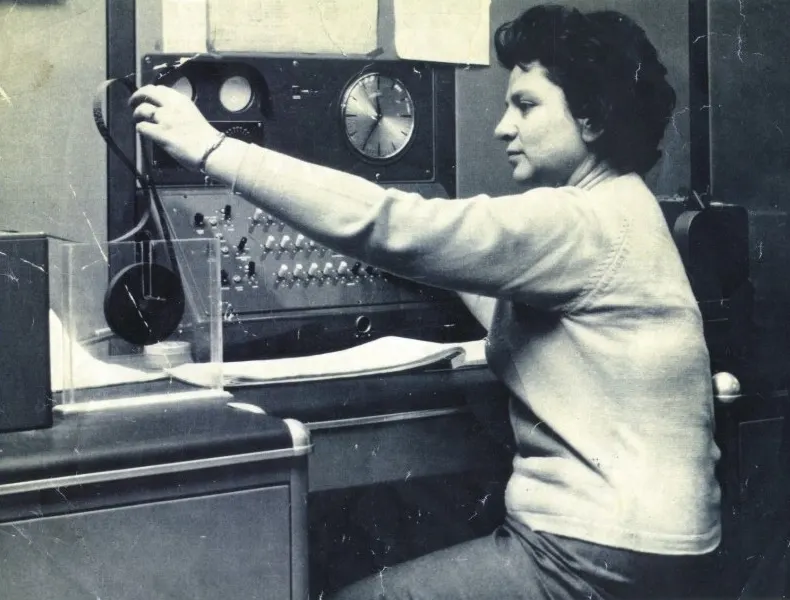
On the image Clementina started running at Exactas in 1961, with Rolando García as dean, and mathematicians, physicists and economists brought their problems to the same machine. The degree takes up that idea: real problems need several disciplines at once and people who know how to use the new tool. Cecilia Berdichevsky operating Clementina, a Ferranti Mercury and Argentina's first scientific computer, at the Instituto de Cálculo of the Faculty of Exact and Natural Sciences, University of Buenos Aires, around 1962. Unknown author, public domain in Argentina, via Wikimedia Commons.
It studies systems where many parts affect one another, such as power grids, markets, hospitals, cities or artificial intelligence systems, and joins mathematics, science and computing with economics, law, institutions and ethics.
It is a degree of the Faculty of Economic Sciences of the University of Buenos Aires. We put it together with teachers and researchers from different parts of the UBA and with people who build technology companies. I am the degree’s director, and this is my page about it. The official reference is the Faculty of Economic Sciences announcement (in Spanish).

Faculty of Economic Sciences, Avenida Córdoba, Buenos Aires, 2012. Photo: OneEuropeanHeart, CC BY 3.0, via Wikimedia Commons.
What a complex system is
A complex system is made of many parts that affect one another, so that what the whole does cannot be explained by looking at each part on its own. Think of a traffic jam. Nobody decides it, each driver reacts to the cars ahead, and one car braking on a highway ends up delaying thousands of people kilometers behind. The same happens with a power grid that fails in a cascade, with a bank run, or with an app that changes what millions of people read.
These systems look very different, but they behave in similar ways. They form networks, adapt, amplify small changes and produce effects nobody planned. Physics, biology, computing and economics each studied those dynamics on their own. Here you learn them together, with the mathematics and computing they require, so you can later move from one field to another without starting over.
The degree prepares you to work on them in three moves.
- Understand. Model the system with mathematics, physics, biology, data and simulation, and know what each model leaves out.
- Decide. Choose what to do with incomplete information, compare alternatives and anticipate how people and institutions respond.
- Build. Design, test and operate technologies, products, organizations and institutions that work inside those systems.
More than the mathematics of complexity
The study of networks, emergence and agent-based models, the tradition often associated with the Santa Fe Institute, has its own 64-hour course, Complex Systems, and builds on the physics, biology, dynamical systems and probability in the curriculum. It is one part. Of the 2,128 hours of coursework, 640 are in decision and game theory, economics, finance, law, institutions, history, geopolitics, negotiation, product design, culture and ethics, and another 480 are the eight workshops, where all of that is combined with technical work. That is where you learn how people decide, how rules are designed, how something real is built and operated, and who answers for the consequences.
Nor is it computer science, economics or engineering with a few courses added. Each discipline contributes tools, and the degree’s own work is to combine them on a concrete problem and carry it through to a decision and something that gets built.
Why it has this name
Almost all of these systems have people, rules and incentives inside them. A traffic-light system that ignores how drivers react, or a financial regulation that ignores how banks respond, fails even when the mathematics is right. That is why the curriculum puts law, finance, game theory, negotiation and ethics next to differential equations and machine learning. The name refers to that shared subject, and it explains why such different disciplines belong in one curriculum.
The name also draws on several traditions. Herbert Simon studied how complex systems are organized, how decisions are made within them and how human-made systems are designed. Rolando García, a former dean of Exact and Natural Sciences at the UBA, developed a way of researching them with teams from different disciplines. Edgar Morin asked how to connect what specialization separates without losing sight of the parts or the whole. The Santa Fe Institute advanced the study of complex adaptive systems and agent-based models. The degree brings these traditions together so that you can understand such a system, decide what to do in it and build something that works.
Why now
Language models write code, summarize papers and put together an analysis in minutes. A prototype or first analysis that used to take a team weeks can now be put together by one person in a few days. When implementation gets cheap, the hard part becomes choosing which problem is worth solving, defining the objective well, checking what the machine returns and taking responsibility for the consequences.
Defining the objective is harder than it looks. A system that optimizes a metric will meet it even if, along the way, it destroys what the metric was meant to measure. A hospital that rewards shorter stays can end up discharging patients too early. With more powerful tools, that mistake happens faster and at a larger scale. That is why the degree teaches you to frame problems, measure what matters and anticipate effects nobody intended.
Artificial intelligence also makes systems more complex. More and more decisions are made by programs that interact with each other, such as algorithms that set prices, grant credit or choose what each person sees. In simulations, and in some real markets too, pricing algorithms have learned to sustain high prices without communicating with each other or being told to. Understanding that collective behavior and designing the rules that shape it is what this degree is about.
And when implementation costs less, a small team can create a product, a company, an organization or a new institution. The workshops prepare you for that. The proposal is to work with artificial intelligence from the first year, verifying what it produces, and three courses, Machine Learning and Model Engineering, Deep Learning and AI Systems and AI, Judgment and Responsibility, study how these systems work and when it makes sense to delegate a decision to them.
What sets it apart
The degree combines scientific foundations for understanding, tools for deciding and workshops for building and testing what you learn.
- A demanding scientific foundation. Mathematics, natural sciences and computing to work with models and evidence.
- Economics, institutions and humanities. To understand incentives, coordination, history, values and consequences.
- Eight integrative workshops. What you learn is applied in increasingly complex projects, from framing a problem to defending the result in public.
- AI and your own judgment. Besides carrying out tasks, you learn to frame problems, verify results and defend decisions.
- Different ways to create. Research, technology, companies and new institutions.
- Credit toward the CBC. The proposal provides that passing the three introductory modules counts for six courses of the Ciclo Básico Común, the university’s common first-year cycle. It works one way only, so having passed those CBC courses does not replace the introductory course.
A complex system in action
A possible project, to show how the disciplines come together. It is not work done by students.
The problem is how to reduce bus waiting times without leaving some neighborhoods less connected. Each discipline contributes a part:
- Mathematics and data. Measure waiting times, demand and uncertainty. The result is a model of the network.
- Computing. Simulate alternative routes and service frequencies. The result is a reproducible simulator.
- Economics. Compare costs, resources and incentives. The result is a feasibility analysis.
- Institutions. Understand the rules, the stakeholders and the agreements needed. The result is an implementation plan.
- Ethics and society. Assess who benefits, who loses and what counts as fair. The result is a set of access and equity criteria.
With all of that you choose an alternative and design a pilot. You weigh the model, the economic feasibility and the effects on people, and decide in advance which results would justify expanding, changing or stopping the intervention. The pilot’s results then help refine the models, reconsider the criteria and revise the proposal.
In the workshops these perspectives come together to justify a decision and build something that can be tested.
Pathway
Each year combines tools, practice and a new capability. The eight workshops connect study with building projects.
Year 1 · Understand
What you learn. Mathematics, natural sciences, programming and history.
What you build. In workshops I and II you frame problems, build proposals and test them.
What it prepares you for. Turning a question into a tractable problem and testing a first solution.
Year 2 · Model and decide
What you learn. Physics, probability, dynamical and complex systems, optimization, computational systems, decision theory, epistemology and ethics.
What you build. In workshops III and IV you work with uncertainty and institutional design.
What it prepares you for. Comparing alternatives, making assumptions explicit and justifying a decision with evidence.
Year 3 · Build and verify
What you learn. Machine learning, artificial intelligence, product design, control, verification, political economy, institutional design and geopolitics.
What you build. In workshops V and VI you tackle critical systems and frame an original project.
What it prepares you for. Assessing a system’s failures and limits, and designing how to check that it works.
Year 4 · Operate and create
What you learn. Causal inference and experimental design, game theory, negotiation, finance, culture, judgment and creation.
What you build. In workshops VII and VIII you develop, evaluate and defend your project.
What it prepares you for. Bringing strategy and execution together in an original contribution, taking responsibility for its results.
All courses
Three introductory modules and 39 curricular units, 31 courses and eight integrative workshops, across four years. Open a course to see its contents, hours and prerequisites. Two-month courses take half of a term. The sequence is the one the curriculum recommends, prerequisites determine when you can take each course, and all three introductory modules are required to start the first term.
Intensive Introductory Course 144 h
I-1 Mathematical Modeling
- Total hours
- 48 h
- Prerequisites
- No prerequisites
Syllabus content
Mathematical representation of relationships, changes and structures. Variables, functions, equations and systems of equations. Proportionality, rates of change and scales. Reading and interpreting graphs. Introduction to mathematical problem formulation. Models as simplified representations: assumptions, parameters, scope and limitations. Computational tools for exploring and representing problems. Elementary problems of counting, frequency, proportion and randomness; intuitive notions of probability and risk; critical interpretation of forecasts and base rates.
I-2 Scientific and Computational Thinking
- Total hours
- 48 h
- Prerequisites
- No prerequisites
Syllabus content
Problem formulation and delimitation. Observation, hypotheses, evidence and argumentation. Distinguishing data, evidence, interpretation and opinion. Abstraction and problem decomposition. Introduction to algorithmic thinking. Information representation and organization. Critical evaluation of sources. Uncertainty, error and result review. Written and oral communication of arguments and procedures. Introduction to forecast calibration, distinguishing uncertainty from lack of knowledge, and recording decisions and assumptions.
I-3 Economics, Institutions and Government
- Total hours
- 48 h
- Prerequisites
- No prerequisites
Syllabus content
Actors, decisions and incentives. Introductory concepts of markets, organizations and the state. Formal and informal institutions. Rules and coordination mechanisms. Public goods, externalities and collective action problems. Power, authority and government. Relationships among economics, institutions and technology. Introduction to analyzing public problems from a systems perspective.
Term 1 Year 1 · 256 h
1 Linear Algebra and Computing I
- Total hours
- 48 h
- Weekly hours
- 6 h
- Prerequisites
- Intensive Introductory Course: Mathematical Modeling; Scientific and Computational Thinking; Economics, Institutions and Government
Syllabus content
Vectors, matrices and systems of linear equations. Gaussian elimination and basic factorizations. Vector spaces, linear independence, bases and dimension. Linear transformations. Inner product, norm, orthogonality and projections. Geometric and computational interpretation. Implementing matrix operations with computational tools. Applications to data, networks, models and optimization problems.
2 Calculus and Analysis I
- Total hours
- 64 h
- Weekly hours
- 4 h
- Prerequisites
- Intensive Introductory Course: Mathematical Modeling; Scientific and Computational Thinking; Economics, Institutions and Government
Syllabus content
Functions of one variable. Limits and continuity. Differentiation and fundamental theorems of differential calculus. Local approximation and Taylor polynomials. Definite and indefinite integration. Fundamental theorem of calculus. Sequences and series. Introduction to formal reasoning through definitions and properties. Applications to change, growth, physics and modeling.
3 Systems Biology, Evolution and Ecology
- Total hours
- 64 h
- Weekly hours
- 4 h
- Prerequisites
- Intensive Introductory Course: Mathematical Modeling; Scientific and Computational Thinking; Economics, Institutions and Government
Syllabus content
Evolution by natural selection. Adaptation, robustness and fragility. Organization of biological systems at different scales. Regulatory networks, homeostasis and feedback. Population and community dynamics. Cooperation, competition, coevolution and symbiosis. Immune systems. Contagion dynamics and epidemiology. Biological systems as complex adaptive systems. Scope and limits of biological analogies applied to technological, economic and institutional systems.
4 History of Institutions, Technology and Power
- Total hours
- 32 h
- Weekly hours
- 4 h
- Prerequisites
- Intensive Introductory Course: Mathematical Modeling; Scientific and Computational Thinking; Economics, Institutions and Government
Syllabus content
Historical formation and transformation of states, bureaucracies, businesses, markets and infrastructures. Relationships between technology and institutional change. Industrial revolutions and transformations of work and production. Science, war, public administration and state capacity. Political, economic and technological power. Path dependence, continuity, rupture and innovation. Emergence and transformation of large-scale infrastructures and platforms.
5 Integrative Workshop I. Problem Formulation, Argumentation and Communication
- Total hours
- 48 h
- Weekly hours
- 3 h
- Prerequisites
- Intensive Introductory Course: Mathematical Modeling; Scientific and Computational Thinking; Economics, Institutions and Government
Syllabus content
Formulating and delimiting complex problems. Identifying actors, components, relationships, scales, constraints and uncertainties. Searching for and critically evaluating information. Critical reading and argumentative writing. Argument structure, identifying assumptions, fallacies, objections and rebuttals. Reasoned reconstruction of alternative positions. Preparing short reports, analytical papers and presentations. Oral communication and reasoned defense. Revision and rewriting. Initial systems analysis of a real problem.
Term 2 Year 1 · 288 h
6 Linear Algebra and Computing II
- Total hours
- 64 h
- Weekly hours
- 4 h
- Prerequisites
Syllabus content
Eigenvalues and eigenvectors. Diagonalization. Matrix factorizations and decompositions. Singular value decomposition. Least squares. Conditioning and numerical stability. Dimensionality reduction. Matrix representations of data, graphs and transformations. Applications to dynamical systems, optimization, data analysis and machine learning. Numerical solution of systems and error propagation in computational examples.
7 Calculus and Analysis II
- Total hours
- 48 h
- Weekly hours
- 6 h
- Prerequisites
Syllabus content
Functions of several variables. Partial derivatives, gradient, Jacobian and Hessian. Constrained and unconstrained optimization. Lagrange multipliers. Multiple integrals and change of variables. Vector fields. Divergence and curl. Line and surface integrals. Green’s and Stokes’ theorems. Applications to physics, optimization, dynamical systems and machine learning.
8 Physics I: Mechanics, Energy and Thermodynamics
- Total hours
- 64 h
- Weekly hours
- 4 h
- Prerequisites
Syllabus content
Quantities, units, measurement and orders of magnitude. Kinematics and dynamics. Newton’s laws. Work, energy, power and conservation principles. Linear and angular momentum. Oscillations and introductory continuous systems. Temperature, heat, internal energy and entropy. Principles of thermodynamics. Physical modeling. Dimensional analysis and experimental uncertainty.
9 Programming, Algorithms and Data Systems
- Total hours
- 64 h
- Weekly hours
- 4 h
- Prerequisites
- Intensive Introductory Course: Mathematical Modeling; Scientific and Computational Thinking; Economics, Institutions and Government
Syllabus content
Modular programming and data abstraction. Fundamental data types and structures. Recursion. Search, sorting and graph algorithms. Algorithmic complexity. Testing, debugging, documentation and version control. Data models. The relational model, query languages, normalization, indexes, transactions and migrations. Specifications, invariants, types, counterexamples and formal reasoning applied to programs. Introduction to the critical use of coding assistants and independent verification of results.
10 Integrative Workshop II. Building, Testing and Breaking Systems
- Total hours
- 48 h
- Weekly hours
- 3 h
Syllabus content
Collaborative design and construction of a functioning system. Requirements and performance criteria. Documentation, testing, instrumentation and peer review. Auditing and adversarial evaluation of other teams’ systems. Identifying and classifying failure modes. Robustness analysis. Reporting and correcting failures. Post-incident analysis (postmortem). Reviewing design decisions and publicly defending results. Short estimation and prediction-tracking exercises; documenting uncertainty and test evidence.
Term 3 Year 2 · 288 h
11 Physics II: Electromagnetism and Signals
- Total hours
- 64 h
- Weekly hours
- 4 h
Syllabus content
Electric and magnetic fields. Electric potential. Current, resistance, capacitance and inductance. Electrical circuits. Introductory electromagnetic waves. Continuous and discrete signals. Time- and frequency-domain representations. Noise and filtering. System response. Applications to sensors, communication, measurement and physical systems.
12 Probability and Statistics
- Total hours
- 64 h
- Weekly hours
- 4 h
- Prerequisites
Syllabus content
Probability spaces, conditional probability and independence. Random variables, distributions, expectation, variance and covariance. Law of large numbers and central limit theorem. Sampling and sampling distributions. Point and interval estimation. Hypothesis testing and statistical power. Bayesian updating, probabilistic prediction and calibration. Introductory regression. Measurement and selection biases. Design of controlled comparisons, randomization, internal validity and threats to inference. Monte Carlo simulation and computational reproduction of results. Introduction to experimental design and its relationship to decision-making.
13 Differential Equations and Dynamical Systems
- Total hours
- 64 h
- Weekly hours
- 4 h
Syllabus content
Ordinary differential equations. Linear and nonlinear systems. State space. Equilibrium and stability. Oscillations and bifurcations. Discrete dynamical systems. Sensitivity to initial conditions. Models of growth, epidemics, control, physics and economics. Introductory numerical methods. Simulation and qualitative analysis of systems evolving over time.
14 Epistemology, Complexity and Ethics
- Total hours
- 48 h
- Weekly hours
- 6 h
Syllabus content
Scientific knowledge, explanation, prediction, causality, models and idealization. Construction of objects of knowledge, abstraction and simplification. Assumptions, scope and limits of representations. Complexity, interdependence, relationships between parts and wholes, and levels of analysis. Articulation of disciplinary perspectives and interdisciplinary research. Falsificationism, paradigms, realism and instrumentalism. Relationships between models and reality. Uncertainty and the limits of inference. Correlation, explanation, understanding and judgment. Fundamental perspectives in ethics. Consequences, duties, rights, justice and responsibility. Epistemological and ethical problems related to automation and artificial intelligence systems: interpretability, bias, errors, alignment, validity, automation and the limits of delegation.
15 Integrative Workshop III. Decision and Operation under Uncertainty
- Total hours
- 48 h
- Weekly hours
- 3 h
Syllabus content
Simulation of critical situations in technical, organizational and institutional systems. Producing and evaluating evidence for decision-making. Diagnosis, prioritization and team coordination. Crisis communication. Decisions with incomplete information and under time pressure. Identifying risks and consequences. Error handling, escalation, recovery and accountability. Post-incident analysis, institutional learning and process improvement. Recording forecasts and probabilities, comparing alternatives, calibration and ex post evaluation of decisions. Design of measurements and simple experiments. Recording hypotheses, assumptions and uncertainties, and revising decisions in light of the evidence obtained.
Term 4 Year 2 · 256 h
16 Computational Systems, Networks and Security
- Total hours
- 32 h
- Weekly hours
- 4 h
- Prerequisites
Syllabus content
Architecture of computational systems and services. Processes, memory, persistence and concurrency. Networks and protocols; communication between processes and services. Principles of distributed systems: replication, consistency and fault tolerance. Latency, performance and availability. Authentication, authorization, secrets management and threat models. Foundations of systems security. Testing, observability, monitoring, recovery and failure analysis. Principles of resilience and controlled degradation.
17 Numerical Methods and Optimization
- Total hours
- 48 h
- Weekly hours
- 3 h
Syllabus content
Rounding and truncation errors; numerical precision, stability and conditioning. Methods for solving linear systems, nonlinear equations and integration problems. Discretization and approximation; validation of numerical results. Unconstrained and constrained optimization; convexity, optimality conditions, gradient methods and iterative algorithms. Computational formulation of real problems, sensitivity analysis and checking assumptions.
18 Decision Theory and Stochastic Processes
- Total hours
- 64 h
- Weekly hours
- 4 h
- Prerequisites
Syllabus content
Decisions under risk, uncertainty and ambiguity. Preferences, utility and expected utility; scope and limits. Bayesian updating, calibration and value of information. Sequential decisions. Multi-criteria decision-making and sensitivity analysis. Heuristics, biases and expert judgment. Elementary stochastic processes: Markov chains, counting processes and simulation. Model uncertainty, deep uncertainty and robust decision criteria. Probability of ruin and distributional effects. Applications to technical, economic and institutional decisions.
19 Complex Systems
- Total hours
- 64 h
- Weekly hours
- 4 h
Syllabus content
Interaction, interdependence, nonlinearity and feedback. Emergence, self-organization and adaptation. Path dependence. Relationships between local behavior and aggregate outcomes. Complex networks, cascades and propagation processes. Agent-based models. Adaptive systems in biology, economics, technology and institutions. Robustness, fragility, resilience and systemic risk. Simulation and visualization. Sensitivity analysis. Scope and limits of prediction and control.
20 Integrative Workshop IV. Institutional Systems Design
- Total hours
- 48 h
- Weekly hours
- 3 h
Syllabus content
Designing rules, processes, mechanisms and institutions. Identifying actors, interests, capabilities and incentives. Cooperation, coordination and conflict. Legal and institutional constraints. Legitimacy and capture risks. Designing institutional interventions and public services. Metrics, auditing, accountability mechanisms and review and appeal procedures. Feasibility and implementation assessment. Argumentation and critical evaluation of institutional proposals. Indicators and basic strategies for evaluating interventions. Comparison groups, selection biases, counterfactuals and the limits of causal attribution.
Term 5 Year 3 · 256 h
21 Machine Learning and Model Engineering
- Total hours
- 32 h
- Weekly hours
- 4 h
Syllabus content
Foundations of supervised and unsupervised learning. Regression, classification, overfitting, regularization and generalization. Model training, validation and selection. Metrics, calibration, error analysis and distribution shift. Reproducibility and critical evaluation of results. Applications of simple models to real data and recognition of inference limits.
22 Product Design, Interaction and Strategies
- Total hours
- 48 h
- Weekly hours
- 3 h
Syllabus content
Research on users, beneficiaries and contexts of use. Identifying needs and formulating hypotheses. Prototyping, interaction design and usability testing. Designing products, services and interventions. Feedback mechanisms, onboarding, error handling and user control. Positioning, adoption and distribution. Pricing, costs, unit economics and sustainability. Defining and analyzing metrics. Technical, economic and institutional feasibility. Evidence-based experimentation and iteration. Products and services based on artificial intelligence: automation, explainability and user control.
23 Control, Observability and Measurement
- Total hours
- 64 h
- Weekly hours
- 4 h
Syllabus content
Modeling dynamical systems. Feedback, stability and dynamic response. Controllability and observability. State estimation. Instrumentation, signals and metrics. Monitoring, dashboards, alerts and anomaly detection. Operational experiments. Effects of metrics on the systems measured and Goodhart’s law. Introductory robust control. Parameter uncertainty and modeling errors. Evaluating strategies under disturbances. Resilience, controlled degradation, fault containment and recovery.
24 Political Economy, Law and Regulation
- Total hours
- 64 h
- Weekly hours
- 4 h
- Prerequisites
Syllabus content
Markets, the state, businesses and institutions. Market failures, public goods and externalities. Distribution and economic power. Political economy of regulation. Interests, regulatory capture, state capacity and compliance. Principles of public law and economic regulation. Competition and concentration. Regulation of technologies, data, platforms, infrastructure and AI. Major traditions of economic thought and their relationships with institutions, technology and crises.
25 Integrative Workshop V. Critical System under Constraints
- Total hours
- 48 h
- Weekly hours
- 3 h
Syllabus content
Designing and building systems or interventions where failure costs are significant. Defining requirements and specifications. Reliability, security, privacy, regulation and operating conditions. Technical, economic, institutional and organizational constraints. Adversarial evaluation and critical review. Risk and failure-mode analysis. Monitoring, documentation, mitigation and recovery strategies. Evaluating robustness to changing scenarios, distribution shift, model uncertainty and correlated failures. Tail risk and decisions under ambiguity. Justifying and defending technical and institutional decisions.
Term 6 Year 3 · 272 h
26 Deep Learning and AI Systems
- Total hours
- 64 h
- Weekly hours
- 4 h
Syllabus content
Deep neural networks. Backpropagation, optimization, regularization and normalization. Architectures for vision, language, sequences and multimodal data. Attention mechanisms and foundation models. Pretraining, fine-tuning and model adaptation. Retrieval-augmented generation. Systems capable of using tools and carrying out sequences of actions. Evaluation of AI models and systems. Security, alignment, oversight and governance. Data, compute, latency and cost constraints. Deployment, operation and monitoring.
27 Institutional Design Laboratory
- Total hours
- 48 h
- Weekly hours
- 3 h
Syllabus content
Diagnosing real or simulated institutional problems. Decision and coordination architectures. Designing rules, procedures, incentives and governance mechanisms. Information, capabilities and power relations. Metrics, controls and accountability. Interaction with relevant actors. Assessing political, legal, operational and budgetary feasibility. Implementation, monitoring and adaptation of institutional arrangements. Presenting and defending proposals. Defining and justifying a measurement and evaluation strategy; designing pilot tests and critically analyzing the validity of the evidence obtained.
28 Formal Methods and Verification
- Total hours
- 32 h
- Weekly hours
- 4 h
- Prerequisites
Syllabus content
Specifications, preconditions, postconditions and invariants. Program contracts and properties. Distinguishing testing, simulation and verification. Introduction to logic applied to systems, deductive verification and counterexample analysis. Computer-assisted tools for checking selected properties. Integrating verification techniques with development, testing and adversarial evaluation practices in Integrative Workshops.
29 Geopolitics, Technology and the International System
- Total hours
- 64 h
- Weekly hours
- 4 h
- Prerequisites
Syllabus content
Power, sovereignty, dependence and interdependence in the international system. Technological and economic competition among powers. The United States, China, Europe and Latin America. Semiconductors, energy, digital infrastructure, data, critical materials and global production chains. Standards, dual-use technologies, economic controls and sanctions. Technological sovereignty, alliances and national capabilities. Systemic risks and transformations of the international order associated with new technologies.
30 Integrative Workshop VI. Final Integrative Project I – Formulation and Validation
- Total hours
- 64 h
- Weekly hours
- 4 h
Syllabus content
Identifying and delimiting a relevant problem and choosing the project pathway: research, development of a technological system, or an entrepreneurial and institutional initiative. Review of prior work and formulation of questions, hypotheses and objectives. Defining evaluation criteria and feasibility conditions. Designing evidence strategies according to the pathway: research and methodological design; specifications and tests for technological systems; research on users or beneficiaries and validation of needs for initiatives. Prototyping, empirical exploration and initial validation. Defining metrics and comparison criteria. Identifying biases, assumptions and uncertainties. Analysis of technical, economic, legal, organizational and ethical constraints. Planning, documenting and justifying the proposal.
Term 7 Year 4 · 256 h
31 Statistical and Causal Inference, and Experimental Design
- Total hours
- 64 h
- Weekly hours
- 4 h
Syllabus content
Advanced statistical inference and uncertainty quantification. Problems of conceptualization, operationalization and measurement. Construct and measurement validity. Sampling, case selection and selection bias. Regression models and their assumptions. Causal identification: randomized experiments, instrumental variables, regression discontinuity, difference-in-differences and other impact evaluation methods. Observational and quasi-experimental designs. Internal and external validity, statistical power and multiple comparisons. Surveys, interviews and other evidence strategies; integration and triangulation of quantitative and qualitative sources. Replication, reproducibility, transparency, research ethics and communication of results. Applications to technical systems, organizations, public policy and integrative projects.
32 Game Theory and Mechanism Design
- Total hours
- 64 h
- Weekly hours
- 4 h
- Prerequisites
Syllabus content
Static and dynamic games. Dominant strategies and best responses. Nash equilibrium. Repeated games. Cooperation, coordination, commitment and reputation. Incomplete information and signaling. Coalitions. Mechanism design. Incentive compatibility and participation constraints. Auctions, allocation, matching, voting and market design. Applications to platforms, institutions, regulation and public policy.
33 Human Behavior, Negotiation and Conflict
- Total hours
- 48 h
- Weekly hours
- 3 h
Syllabus content
Cooperation, conflict, trust and reciprocity. Distributive and integrative negotiation; alternatives to negotiation, credible commitments and coalitions. Persuasion, leadership, power and asymmetries. Team dynamics, collective action, institutional cooperation and conflict. Collective decisions under pressure and uncertainty. Simulations, analysis of results and critical review of negotiation strategies.
34 Integrative Workshop VII. Final Integrative Project II – Development and Evaluation
- Total hours
- 80 h
- Weekly hours
- 5 h
Syllabus content
Developing, implementing or operating the project formulated in the previous stage. Producing results and obtaining evidence of performance, validity, replicability, use, demand or impact, according to the pathway. Defining and tracking metrics and evaluation procedures. Managing resources, agreements, risks and constraints. Revising hypotheses and execution strategies in light of the evidence obtained. Testing, experimentation and reproducible documentation. Recording and analyzing decisions, assumptions, negative results and changes of direction. Presentation and reasoned defense of progress and results.
Term 8 Year 4 · 256 h
35 Finance, Money and Banking
- Total hours
- 64 h
- Weekly hours
- 4 h
Syllabus content
Financial statements, cash flows, budgets and valuation. Investment and financing decisions. Risk, return, liquidity, leverage and capital structure. Money, credit, banking intermediation and payment systems. Central banks, monetary policy, interest rates and inflation. Counterparty risk, financial contagion and systemic fragility. Crisis models, uncertainty, risk of ruin and limits of financial measurement. Critical evaluation of financial institutions and decisions in national and international contexts.
36 AI, Judgment and Responsibility
- Total hours
- 32 h
- Weekly hours
- 4 h
Syllabus content
Transformations associated with the expansion of AI and automation. Capabilities and limits of contemporary AI systems. Relationships among prediction, recommendation, decision and judgment. Automation and limits of delegation. Human agency and oversight. Responsibility for decisions assisted or executed by automated systems. Alignment, institutional power and legitimacy. Accountability and review mechanisms. Case analysis and reasoned defense of positions.
37 Culture, Legitimacy and Informal Institutions
- Total hours
- 32 h
- Weekly hours
- 4 h
Syllabus content
Culture, social norms and informal institutions. Formation and transmission of shared meanings. Authority, legitimacy and obedience. Trust, reputation, identities, rituals and symbols. Relationships between formal and informal institutions. Collective action, symbolic coordination and normative change. Cultural conflict. Acceptance, appropriation and resistance to technologies and interventions. Relationships among effectiveness, legitimacy and public responsibility in technical and institutional systems. Anthropological and cultural-evolution perspectives applied to institutional analysis.
38 Creation, Aesthetics and Responsibility
- Total hours
- 32 h
- Weekly hours
- 4 h
Syllabus content
Creating knowledge, technologies, products, organizations and institutions. Criteria of quality, usefulness, beauty, elegance, meaning and value. Forming, justifying and discussing aesthetic and professional judgments about what one creates. Perspectives from moral philosophy and the philosophy of technology applied to creation and decision. Tensions among effectiveness, legitimacy, sustainability and responsibility. Duties toward users, communities, teams and institutions. Integrity, conflicts of interest and unintended consequences. Reflection on one's professional path, the country, the final project and responsibility for what one chooses to build.
39 Integrative Workshop VIII. Final Integrative Project III – Completion and Public Defense
- Total hours
- 96 h
- Weekly hours
- 6 h
Syllabus content
Integration and completion of the project developed in Workshops VI and VII. Consolidating research results, a technical system or an entrepreneurial and institutional initiative. Evidence of validity, reproducibility, use, performance, demand or impact, as appropriate. Feasibility, sustainability, risks and consequences. Retrospective review of decisions and their limits. Comprehensive documentation and a proposal for continuation, transfer, further development or closure. Public defense before an external panel of the work, evidence, learning, the student's own contribution and the project's limits.
Course map and prerequisites
Each arrow goes from a required course to the course it unlocks, and the columns show the recommended order, not additional requirements.
How you learn
The curriculum combines depth in each discipline with work that brings them together. Courses provide concepts and methods, and workshops combine them in problems that require framing, building, testing and justifying decisions.
- Scientific foundations. Mathematics, physics and biology to understand models, constraints and evidence.
- Technology and systems. Programming, data and artificial intelligence to implement and verify solutions.
- Economics and institutions. Incentives, resources, rules and coordination so that an initiative can work.
- Judgment and responsibility. History, ethics and culture to discuss ends and take responsibility for the consequences.
Eight integrative workshops connect the courses with increasingly complex problems. Building includes framing, testing, getting it wrong, revising and communicating. Assessment combines individual understanding, collaborative work, documentation and oral defense. The proposal is that AI use is recorded and its results verified.
Starting ventures
The workshops offer a path for turning ideas into projects: understand a need, build a solution, test it and work out how to sustain it.
- Discover and validate. Identify real problems, talk to potential users and test assumptions before investing in a solution.
- Build and launch. Develop prototypes, organize teams and run pilots to assess usefulness, costs and results.
- Sustain and seek funding. Prepare a business or sustainability model, assess funding options and present the project to potential partners.
For students who want to start something, we propose building a support network of mentors, organizations willing to host pilots and connections to sources of funding. That network is still being put together. Its participants will be announced when confirmed, and it does not mean guaranteed funding.
Starting a company is one possible path, alongside research, technological development and the creation of new institutions.
Final project
Workshops VI, VII and VIII make up the Final Integrative Project, which ends with a documented piece of work and its public defense before a panel. The project can take one of three forms, with the same demands of rigor, autonomy and documentation.
- Research. Produces original knowledge and results. Method, results and reproducibility are assessed.
- Development of a technological system. Builds a system that works. Specifications, tests and performance are assessed.
- Entrepreneurial and institutional initiative. Creates a company, an organization or an intervention. Validation, operation and adoption or impact are assessed.
Three possible projects, one for each form. They are illustrations, not work done by students.
- What makes a network withstand a failure? Mathematics, computing and research. You form a hypothesis about networks, build a model and compare its predictions with data or experiments. You have to show a precise question, reproducible results and an account of their limits.
- How do you design an AI system you can trust? AI, verification and judgment. You build an assistant for querying documents and evaluate when it answers well, when it fails and when it should ask for review. You have to show a working system, performance tests and oversight criteria.
- How do you improve a service nobody can change alone? Institutions, product and economics. You investigate a coordination problem and design an initiative with the people involved, testing its rules and the conditions for it to be viable. You have to show a validated proposal, a pilot and evidence that it works or of where it falls short.
Admissions
This degree is for you if you want to combine scientific training, technological development and an understanding of social and institutional problems.
- Willingness to study mathematics and learn to program.
- Curiosity about science, society and institutions.
- Wanting to build with others and revise your own ideas.
The program is demanding. It includes an intensive introductory course and both individual and collaborative work. You do not need to arrive with all the answers.
To enter you need to have finished secondary school. Exceptionally, people over 25 who have not can enter by passing the assessments set by the regulations. To graduate you must pass the introductory course, the 39 courses and workshops and the Final Integrative Project, and demonstrate an advanced level of English.
FAQ
What is the status of the degree?
The UBA Faculty of Economic Sciences announced the launch of the degree on November 4, 2026, with a public presentation on November 11. The curriculum takes effect upon approval by the Superior Council of the University of Buenos Aires.
How long is it and how is it taught?
Four years, eight terms, in person. It includes 144 hours of introductory course and 2,128 hours of regular coursework, 2,272 hours in total. Some courses last two months and others a full term.
How is artificial intelligence used?
The teaching combines moments where you show your own understanding with AI-assisted activities. Using a tool does not replace verifying its results or being able to explain the decisions you made.
Why is it called Complex Systems?
Because it studies systems made of many parts that affect one another, such as a power grid, a market or a city, where what happens to the whole cannot be explained by looking at each part. These systems behave in similar ways, and the degree teaches you to understand them, decide within them and build what works. I explain it in detail in What a complex system is, and the full rationale is in the curriculum.
What work will it prepare me for?
There is no single path. The degree is aimed at research, technological development and creating or running business and institutional initiatives. Some examples: planning and operating energy or transport networks, managing risk at a bank or an insurer, evaluating public policy, working on product or artificial intelligence teams, strategy consulting, research, or starting your own company. When a task is reserved by law for another degree, it is done in a team with those professionals. The proposed professional scope of the degree is set out in the curriculum, and no specific job is guaranteed.
Who will teach, and when does it start?
The faculty, location, calendar and enrollment conditions will be announced when they are confirmed. In the meantime you can read this page and the full curriculum.
The full text of the plan, with its rationale, objectives, professional scope and the minimum contents of every course, is on the Curriculum page, a reference translation of the Spanish original. You can also download it as a PDF (in Spanish).