Solving Futbol Like Chess
European futbol optimized what is measurable and converged on a monoculture. On variance, the duel, deep blocks, and the danger of optimizing proxies.
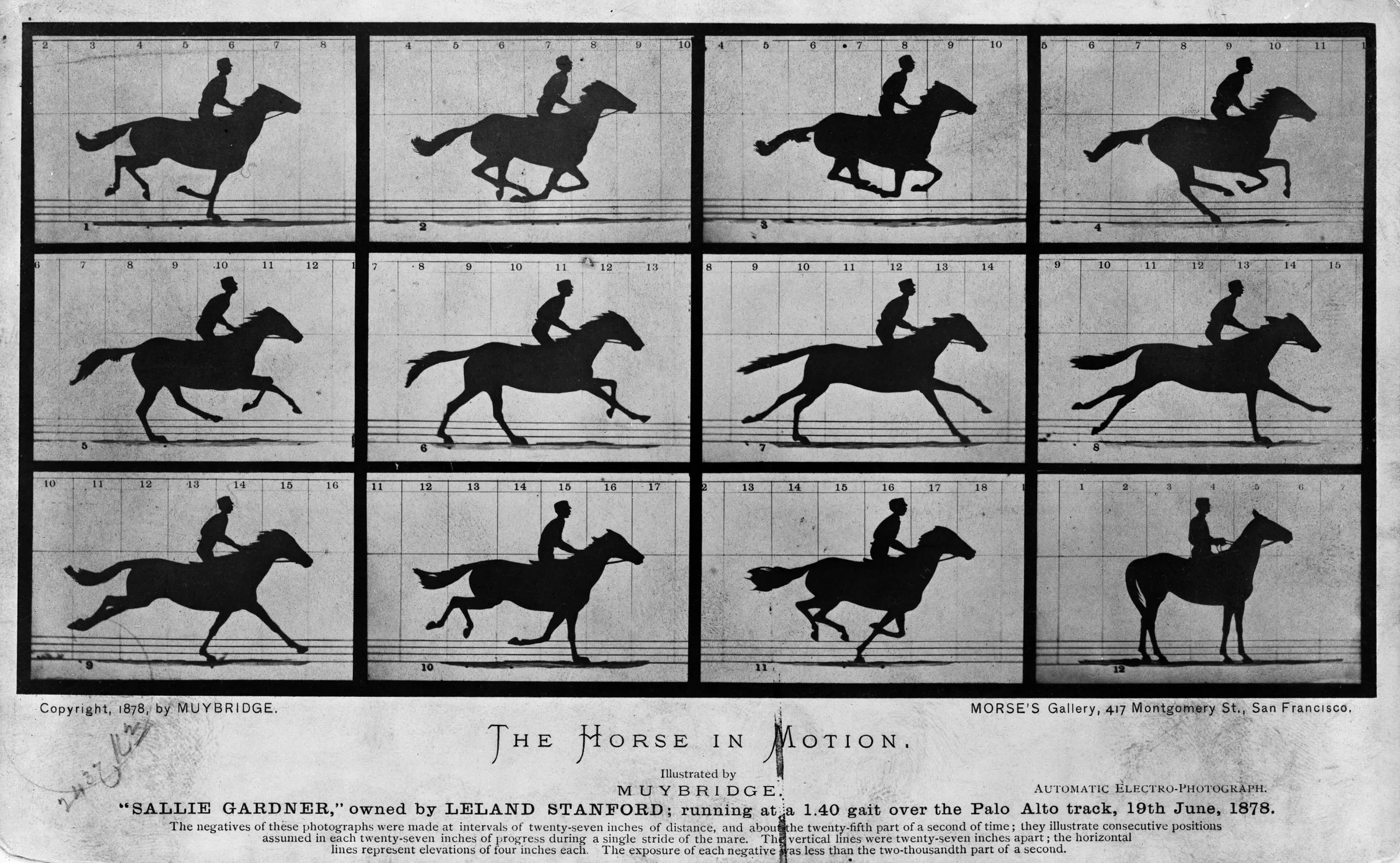
On the image Muybridge’s cameras made the gallop measurable for the first time. Once something can be measured, people start optimizing it, which is the story this essay tells about European futbol. The Horse in Motion, Eadweard Muybridge, 1878. Public domain, via Wikimedia Commons.
European futbol has spent the past fifteen years solving the game like chess.
A generation of coaches optimized for pass completion, pressing triggers, territorial control, rest defense, and positional occupation. The problem is that they optimized for what is measurable. Attacking space early, attempting the difficult pass, dribbling past a defender, deliberately creating chaos: these are high-variance plays. They fail more often than they succeed. If you evaluate players by completion rate, ball retention, or positional discipline, those actions look like mistakes. So they get coached out. Eventually, everyone converges toward the same local optimum.
The analysts eventually noticed, and modern models now reward the risky forward actions the old metrics punished. But the correction arrived too far up the pipeline. Academies still select for legibility: the kid who holds his position and completes his passes gets promoted, the one who loses the ball five times trying the pass that breaks the match open gets corrected. By the time a player is old enough to be measured properly, the variance is gone.
The game becomes increasingly legible. Every team occupies similar spaces, presses in similar ways, builds from the back with similar patterns, and minimizes the same risks. Systems become better at defeating other systems, but worse at dealing with players who refuse to behave like systems.
The convergence is also enforced by moral language. Possession is virtuous, attacking is brave, defending is a confession of inferiority: they parked the bus, they played anti-futbol, they didn’t deserve to win. This is nonsense. Every tactic is a rational answer to a problem, not a moral position. The problem is your players, the opponent, the score, the stakes. Playing open against a superior team means competing on exactly the terms where you are weakest. That is stupid. The intelligent answer is to compress the space, defend as a unit, and threaten in transition. And it is hard: keeping eleven players organized for ninety-plus minutes, shifting as a block hundreds of times, staying concentrated when one lapse ends the match. Most teams can’t do it. The defensive masterclass looks passive precisely because its excellence is invisible.
The dribbler and the deep block look like opposites, but they are the same bet. A low block compresses the match into a handful of chances, and fewer chances means more variance in the result. The favorite wants many events so that quality wins. The underdog wants few so that luck matters. The duel is the same wager inside a single play: fail five times for the one action nobody can plan against.
Europe’s best attackers right now are duel players: Yamal, Vinicius, Doku, Musiala. The system isolates them high and wide against a fullback because it cannot generate what they do, only the conditions for it. Positional futbol industrialized the deployment of the 1v1; it never learned to produce it. South America still does, not because its coaches are romantics but because formation there runs through street futbol, futsal, and late systematization, where the only way to survive is to beat the man in front of you. Europe buys back the variance its academies coached out.
Argentina in 2022 is the proof. Scaloni’s team was structurally modern, and it kept everything the dogma discourages: the tactical foul, the provocation, the willingness to let a match turn ugly when ugliness favored them, and a player whose entire game is the refusal to behave like a system. They won the World Cup.
Italy may have been the first futbol culture to lose its identity this way, which is ironic because the systematization began there: Sacchi’s Milan is a direct ancestor of modern pressing. But Italy’s advantage was never positional perfection. It was asymmetry, unpredictability, an instinct for making matches uncomfortable. Even catenaccio was less a style than a weapon. Converging on a model partly descended from its own export, Italy surrendered what made it different, and missed two World Cups.
Since Guardiola, elite futbol has one template: possession as a first principle, patient build-up, endless circulation until a gap appears. In the right hands it is magnificent and it wins everything. But it has hardened into dogma. Futbol is not won by completing the most passes. It is won by scoring more goals than the other team. Sixty-eight percent possession, six hundred passes, sideways and backwards and sideways again, and nothing at the end. Possession without penetration is decoration. The team recycling the ball for its own sake is avoiding risk, prioritizing not losing over winning, and calling it a philosophy. Sterile possession is risk aversion in a nicer suit. Meanwhile the low block that beats it every season gets called cowardice.
Futbol’s greatest eras were defined by variety, not conformity: catenaccio, total futbol, direct play, gegenpressing, the deep block, each an answer to a real problem. This is the danger of optimizing proxies. When a measure becomes a target, it stops being a good measure. When everyone optimizes the same measurements, they stop optimizing for victory and start optimizing for looking efficient. Metrics become targets. Proxies replace objectives. Variance is mistaken for error. The outliers capable of breaking the system disappear because the system itself learns to eliminate them.
Written with an LLM in the loop, like everything here. The ideas and the mistakes are mine. More on how I write.